
Clay’s recommendations on the best books on the Lewis and Clark Expedition.
Several people have asked me for a list of books to read about Lewis and Clark. For the sake of proportionality and brevity, I will list only a few.
There are many one-volume editions of the journals. I grew up on The Journals of Lewis and Clark, edited by the great historian Bernard DeVoto. It is still in print. It was the first abridgment that used the original journals. The best recent edition is Gary Moulton’s The Lewis and Clark Journals: An American Epic of Discovery. If you want the emphasis to be on natural history, I suggest The Journals of Lewis and Clark, edited by Frank Bergon (Penguin).
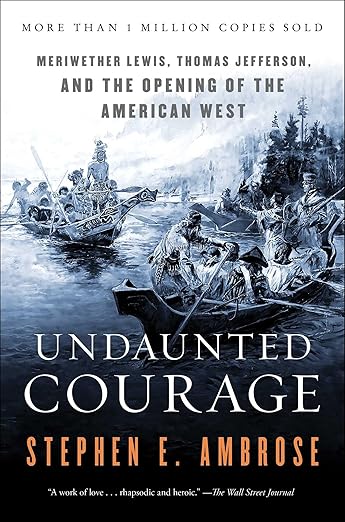
Stephen Ambrose’s Undaunted Courage is still (and may always be) the best one-volume history of the expedition. Published in 1996, it holds up well, reads like a novel, and provides excellent portraits of the expedition’s mastermind, Thomas Jefferson, the two captains, and Sacagawea, and explores the major themes of the expedition without ever descending into academic jargon.
The most important book about Lewis and Clark in my lifetime is James Ronda’s pathbreaking Lewis and Clark Among the Indians (1984), a revolutionary book that unleashed amazing new insights by simply turning the lens and looking at the expedition through Native eyes.
My friend David Nicandri wrote River of Promise: Lewis and Clark on the Columbia. As the title suggests, Nicandri explores the expedition on the Pacific side of the Rocky Mountains. In an interview I conducted with James Ronda in 2005, he stated that River of Promise was one of the two or three best books written about Lewis and Clark during the expedition’s bicentennial (2003–2009).
It’s hard to find a good book about Sacagawea because we actually know very little about her, and therefore, most of what has been written has inevitably been speculative. I think Donna Kessler’s The Making of Sacagawea: A Euro-American Legend is the best because she reminds us that Sacagawea is always a projection of our culture’s need to claim this Shoshone-Hidatsa woman and fit her into our latest cultural agenda.
David Freeman Hawke’s Those Tremendous Mountains: The Story of the Lewis and Clark Expedition is the best alternative to Stephen Ambrose. It is shorter and tighter than Undaunted Courage. It was the first book I ever read on Lewis and Clark, and I was shocked when I turned a late page in the book and learned that Mr. Lewis had committed suicide three years after the expedition.
My own The Character of Meriwether Lewis: Explorer in the Wilderness is my attempt to explore this fascinating, complex, brilliant, erratic, and tragic hero at the center of what James Ronda has called “America’s first great road story.”
Here are a few more options for those who want to delve deeper: John Logan Allen’s Passage Through the Garden: Lewis and Clark and the Image of the Northwest; Larry Morris’s The Fate of the Corps: What Became of the Lewis and Clark Explorers After the Expedition; Thomas Slaughter’s Exploring Lewis and Clark: Reflections on Men and Wilderness; Albert Furtwangler’s Acts of Discovery: Visions of America in the Lewis and Clark Journals; David Nicandri’s Lewis and Clark Reframed: Examining Ties to Cook, Vancouver, and Mackenzie.
I should add that here you can find a complete, searchable, and free electronic edition of the journals of every expedition journal keeper.