
The art of listening and genuine communication to a thriving democracy.
I don’t know if you remember the song by Fred Neil, Everybody’s Talkin’, written in 1966 and released two years later: “Everybody’s talkin’ and I don’t hear a word they’re sayin’.” That seems to be where we are. Sometimes, when there is a flashpoint issue, such as sending a fleet of B-2 bombers to attack installations in a foreign country, I watch an hour of FOX followed by an hour of MSNBC. Here’s what I learn. There is very little news and a great deal of punditry. To watch them is to conclude that we live in two profoundly different Americas and that each one regards the other as evil, fundamentally misguided, brainwashed, and unworthy of a moment’s respect. The Democrats are Marxists (sometimes even Maoists). The Republicans are Fascists. And, of course, we know that neither is either. One side defends the president’s action without the slightest hint of doubt. The other side denounces the same action without the slightest nuance.
The truly mind-blowing aspect of this is that if the president were from the other party and engaged in the same action, the arguments would be identical but in the opposite direction. This is the very definition of hypocrisy.
Everybody’s talking, but they are only talking to their echo chamber, and the willing subscribers to that echo chamber swallow the Kool-Aid unhesitatingly and try to remember the talking points so they can trot them out when they meet their like-minded friends for coffee. People tend to hear what they want to hear on all issues, and they often dismiss and denounce that which they don’t want to hear.
If we were truly a republic, the discussion would begin with an attempt to establish all the common ground before proceeding to discern the areas of genuine disagreement. (In foreign policy, it used to be said that “politics stops at the water’s edge,” but that notion, which was probably always a myth to a certain extent, has long since been relegated to the bin labeled, “What world do you live in?”) If we were truly a republic, each side would listen to the other carefully and then say, “I hear you, and I don’t entirely disagree, but I think you are wrong about the fundamental issue.” And the other side would say, “Thank you. I get your point about … but I believe nevertheless ….”
Thomas Jefferson championed freedom of speech (and press) on the principle that in a free marketplace of ideas, good ideas would triumph over bad ones, truth over error, science over superstition, and if we all agree to engage in mutually respectful argument and accept that compromise is the essence of democracy (without which you can have no democracy), we will usually do the right thing in the end. In his first inaugural address (March 4, 1801), Jefferson wrote: “We are all Republicans. We are all Federalists.” Translation? Hey, we’re all Americans. We agree on much more than we disagree about.
When I hear people express their opinions in very strong terms, I sometimes ask, “What would it take to change your mind about this?” This is an increasingly silly exercise.
Baked In
It was around 2016 that I first heard the term “baked in.” As in the CNN dialogue:
— Will this change the American public’s view of Donald Trump?
— No, people’s views on this are baked in.
At first, I resisted this phrase and the idea. But now I think we are baked in about almost everything. Dating back to Theodore Roosevelt and later Bob Dole, the Republicans were for a national health care system more or less like the one Republican Governor Mitt Romney enacted in Massachusetts in 2006, which was not significantly different from the Affordable Care Act of 2010, but when President Barack Obama proposed the ACA, it was denounced by Republicans as the death of civilization as we know it. The Democrats were for a border “fence” in 2006, but when President Trump insisted on one in 2017, they regarded it as cruel, inhumane, and unlikely to achieve its ends.
And yet approximately 70% of the American people live not at the Democratic far end of the political spectrum nor the Republican far end but in the forgotten and radically underrepresented middle. That’s the America I want to live in. I like the POTUS channel’s Michael Smerconish’s theme song: Stuck in the Middle with You.
Here are questions that haunt me, especially as I am self-consciously and at great expense traveling the country to Listen to America.
- What does it really mean to listen? I can listen to the Grateful Dead. I can listen to the news. I can listen to a sermon in church. I can listen to my friend whine about her retirement account. But am I really listening?
- What does it mean to listen? By which I mean really listen, listen generously and with respect, listen with the possibility that my mind might be changed? Listen so that I can repeat the other’s statement(s) faithfully.
- Do people change their minds? If so, what does it take for someone to change their mind? When was the last time I changed my mind?
- What does it mean to have an open mind? Do I have an open mind?
- Does argument (in the political sense, not the argument about who takes out the trash) ever accomplish anything?

The great figures of the Enlightenment (think of Denis Diderot, Voltaire, and Thomas Jefferson) believed that skepticism and doubt were the essential tools of an enlightened person. Diderot (1713–1784), the creator of the seminal Encyclopédie (28 volumes, 1751–1772), humankind’s first attempt to create a digest of all human knowledge, said, “All things must be examined, debated, investigated without exception and without regard for anyone’s feelings.” And he said, “We swallow greedily any lie that flatters us, but we sip only little by little at a truth we find bitter.”
If I start a harmless thread on Facebook saying that last Thursday I bought four skeins of red yarn at Hobby Lobby, and a I get 100 responses, it is not long before someone says, “I can’t believe you shopped there, you know they are right-wing nutjobs,” and then someone says, “Red, huh, what have you gone all MAGA on us?” And then someone says, “Who cares if they are Christians, we all know there is no God.” And then someone says, “My cat ate two feet of the yarn I am using to make an afghan for my niece.” And then someone says, “Obama was the worst president in American history except for Biden, who wouldn’t know Hobby Lobby from Hopalong Cassidy.” And then someone would say, “I never shop on Thursdays because that’s the day I binge-watch Blue Bloods.” Then, “Blue Bloods!? Don’t you know that show perpetuates racist policing?”
If you think I’m exaggerating, spend some time on Facebook.
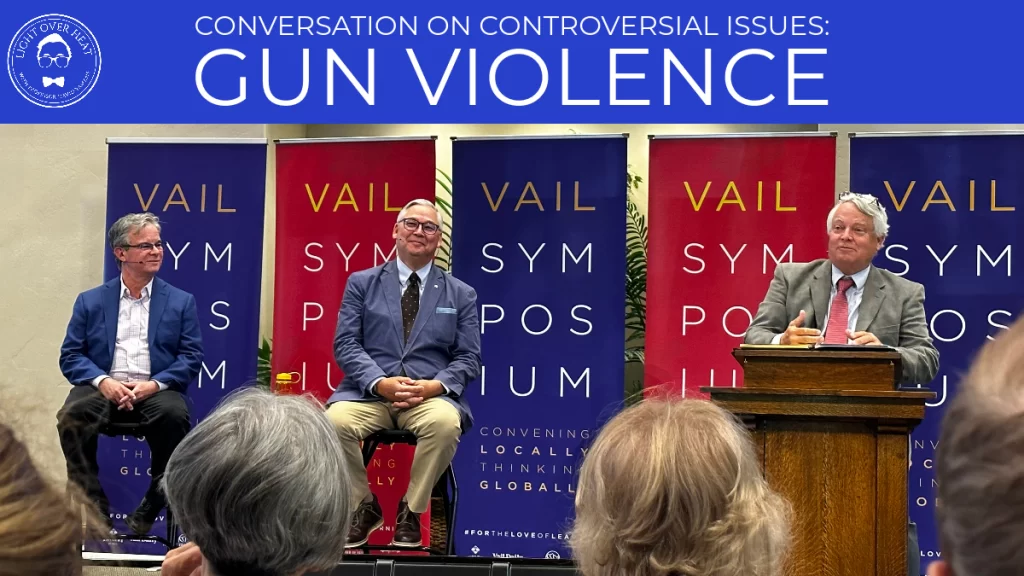
My whole world is discourse. I read incessantly, listen to podcasts, watch documentaries, and engage in conversation with a wide variety of people all over America and sometimes beyond, at least half of whom see the world quite differently from me. I lecture, write, broadcast, post, and podcast. For the past few years, I have moderated a series of programs in Colorado for the Vail Symposium on Controversial Issues. In each case (immigration, censorship, education, and sports), we bring in people from both sides of the issue, and to prepare, I read books on the subject from various points of view before we assemble on stage in Vail. I believe we can have honest and valid disagreements on the major questions: guns in America, violence on television, the future of immigration, the perceived crisis of the Supreme Court; bias in the media, the future of health care, white–Indian relations; statue removal; gender construction; the future of rural life; separation of church and state, etc.
I believe there is never just one point of view on most questions. To be enlightened is to doubt your own convictions, especially your strongly held ones. You may not change your mind, but you will refine your views by questioning them honestly.
When I host cultural retreats, I sometimes lead people through an exercise in which we first state our strong opinions and convictions on a controversial subject, and then I ask people to make the best argument they can for the other side, for the other point of view. Some people refuse to entertain the other perspective. Apparently, they own the truth. Others find this exercise very satisfying.
The great English philosopher Bertrand Russell said, “The fundamental cause of the trouble is that in the modern world, the stupid are cocksure while the intelligent are full of doubt.” The Irish poet William Butler Yeats said this even more pointedly:
The best lack all conviction, while the worst
Are full of passionate intensity.
All you can say to this is: yup.
The Question of Credibility and Authority
I was the moderator of an evening program in Vail, Colorado, the other day about whether we are in a constitutional crisis due to the actions of the current president. About two-thirds of the way through the program, an eminent retired federal judge, widely regarded as “the most conservative judge in the country,” stood up and said, “We are not only in a constitutional crisis, but we are in clear and present danger of losing the republic.” He had given some of the finest testimony at the Congressional January 6 hearings. If anyone has street cred on this issue, it is he — more than anyone in that room. And yet, people who didn’t want to hear this later complained bitterly that he doesn’t know what he’s talking about, that he’s “bat-s… crazy,” that he’s just an old man, that we had no right to give him the chance to speak, etc. I believe there is room to argue about a subject of this gravity, but my point is that, despite his 40-year distinguished career, his opinion was immediately discounted by those who didn’t want to hear it. I would have thought that everyone in that room, regardless of their political outlook, would have said, “Wow, I’m not entirely sure I agree, but it would be a great mistake not to take that statement very seriously.”
You know the argument from Plato. If you want your horse shoed, do you go to a farrier or a poet? If you want to determine whether you need heart bypass surgery, do you go to a banker or a heart surgeon? (Actually, you had better do both!) If you want to understand the doctrine of the Trinity, do you go to a gymnast or a theologian?
Nobody in that room knew more about the Constitution of the United States than this eminent judge, and yet those who did not like what he said seemed to regard him as just some senior citizen who stood up to bloviate.
The same is true on global climate change. People who have never read a book on the subject and could not even begin to explain how carbon affects the biosphere make bold, even absolutist, declarations about climate. I do believe there is room for an honest, nuanced, and serious debate about anthropogenic climate pressures, but if you are the senior senator from Oklahoma, hold up a snowball on the floor of the United States Senate on a cold day in Washington, and say, “There’s your global warming!” you are not interested in serious debate or, for that matter, science. I was on a plane a dozen years ago with a vice president of a Great Plains-based electric cooperative. Curious and thinking this was a good time to hear from someone deep in the industry, I asked him what he thought about global climate change. He said it was all nonsense, but his energy cooperative paid lip service to the issue so as not to lose federal funding. I asked him why it was nonsense. He trotted out the true (but anecdotal) evidence that a handful of scientists had fudged some of their data to make things seem worse than they are. I freely admit that I know very little about this issue. Still, I do know that more than 95% of the world’s climate scientists (every one with a PhD in climate science) believe not only that humans have raised the planet’s temperature but also that this represents a gravely serious threat to the future of civilization (and countless non-human species). He told me that such people are alarmists, that they are liberals, that they are bandwagoning opportunists who know that’s how to get grants and funding, etc. At this point, without the slightest hint of sarcasm, I asked him what he had read about the issue. He hemmed a bit and then said, “Well, I’ve read a couple of magazine articles.” If he had said, “Last year, I read ten juried articles and two books on the subject, including books of the ‘sky is falling’ perspective,” I would have had to take his argument seriously because he’s in the industry and I’m just a guy.
A New Curriculum
I’m sure I am guilty of all these problems, so I’ll be the first to sign up for the new curriculum. Here are the courses:
— Argument from evidence.
— Avoiding logical fallacies, such as arguing from anecdotal “evidence,” reductio ad absurdum, ad hominem, special pleading, red herrings, straw man arguments, riding one’s hobby horse, etc.
— Generous and respectful listening.
— Discerning truth from propaganda.
— Stipulating the validity of the other’s perspective.
— Understanding that democracy is compromise.
— Weighing a person’s credibility and authority.
— Opening your mind without LSD or Ecstasy.
In the spirit of this essay, I close with the refrain of one of my favorite essayists, Michel de Montaigne (1533–1592):
“Que sais-je?” Translation? “What do I know?” That’s always the best place to start.