
After some 30,000 miles on the road, a short report on the RV Life.
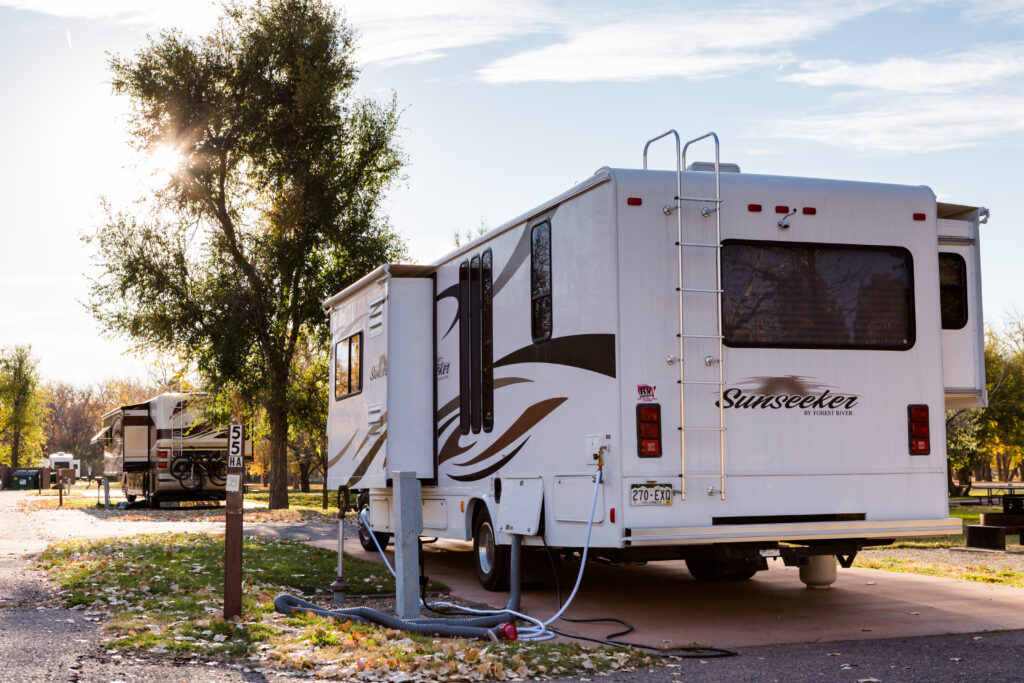
I’ve been asked repeatedly to describe what RV life is like out here. So here’s a preliminary report.
One-sentence report: I’m loving it, thriving, exploring America, meeting interesting and often fascinating people, listening to the land and the people on it, reading and writing more than usual, listening to audiobooks as I drive, and eating most of my meals in my own little aluminum cabin on wheels.
There are two basic types of campgrounds — commercial RV parks, such as KOA and Good Sam, and then there are what I’ll call ma-and-pa campgrounds. The clientele is different in each.
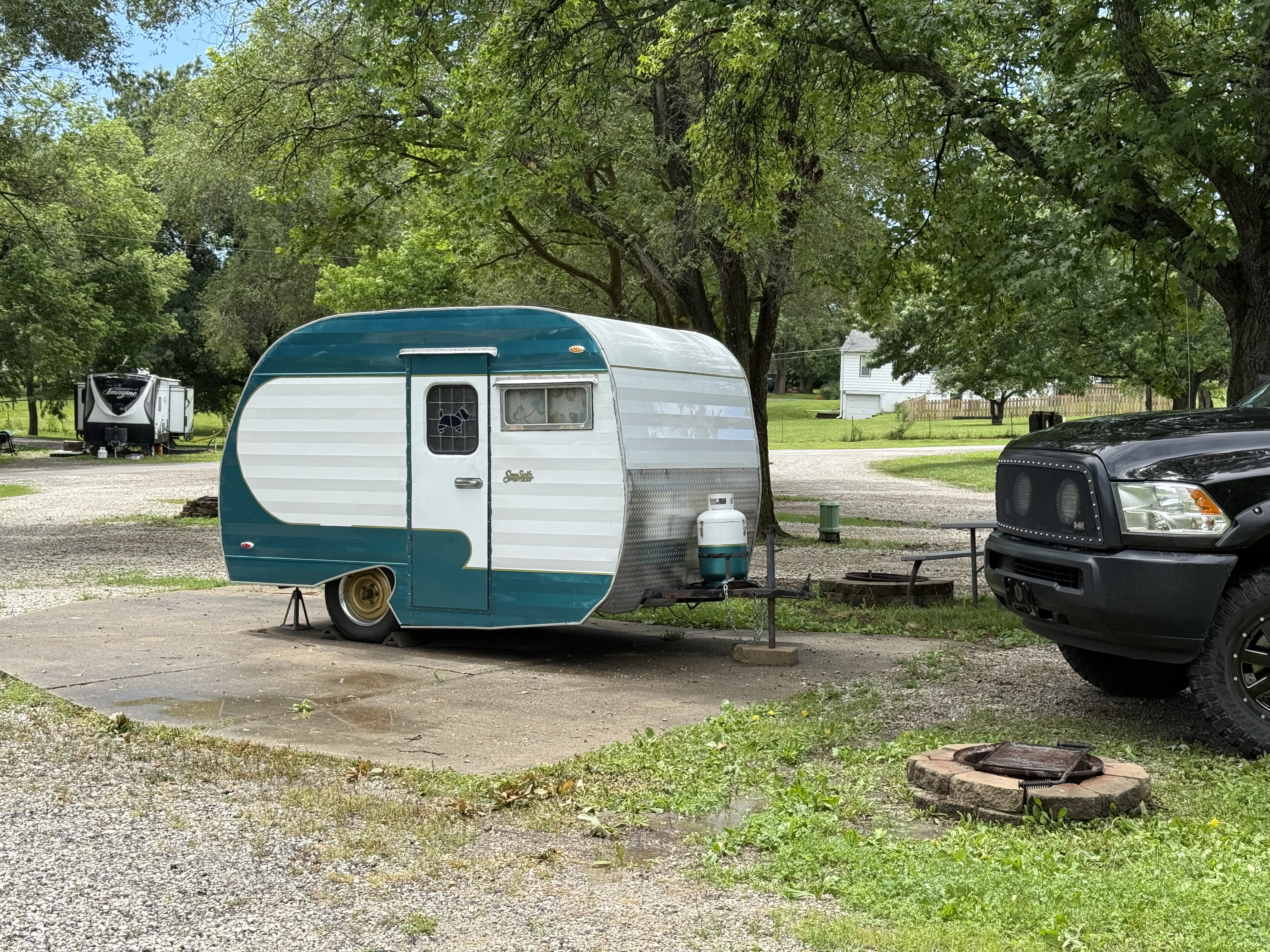
Tonight, I’m at a lovely non-corporate RV campground just a few miles north of Columbia, Missouri. There are no frills here, but the amenities include a game room, showers, picnic tables at each site, and an excellent laundry facility. I’m sitting out at the modest picnic table — the wood would appreciate treatment but is unlikely to get it — at slip 45. There are large pull-type RVs on both sides of me (44 and 46), and, across a broken asphalt lane, more than a dozen RVs lined up like a package of link sausages — from buses to one pink-and-white rounded 1950s camper trailer. The oldest of these RVs, a wee trailer manufactured back when aluminum was a new thing, undoubtedly has dark oak paneling inside. And a Formica table. But I have a Formica table in my Airstream, too. I’m guessing there are approximately 60 RVs in this campground, which is at about 70 percent occupancy. About a third are long-term campers. You can tell they’re here indefinitely because they set up housekeeping with potted plants, dog fences, plastic storage bins, outdoor carpets, Weber grills, bicycles, mopeds, and other stuff you’re more likely to see in a trailer park than in a suburban subdivision, where that’s all tucked into a three-car garage.
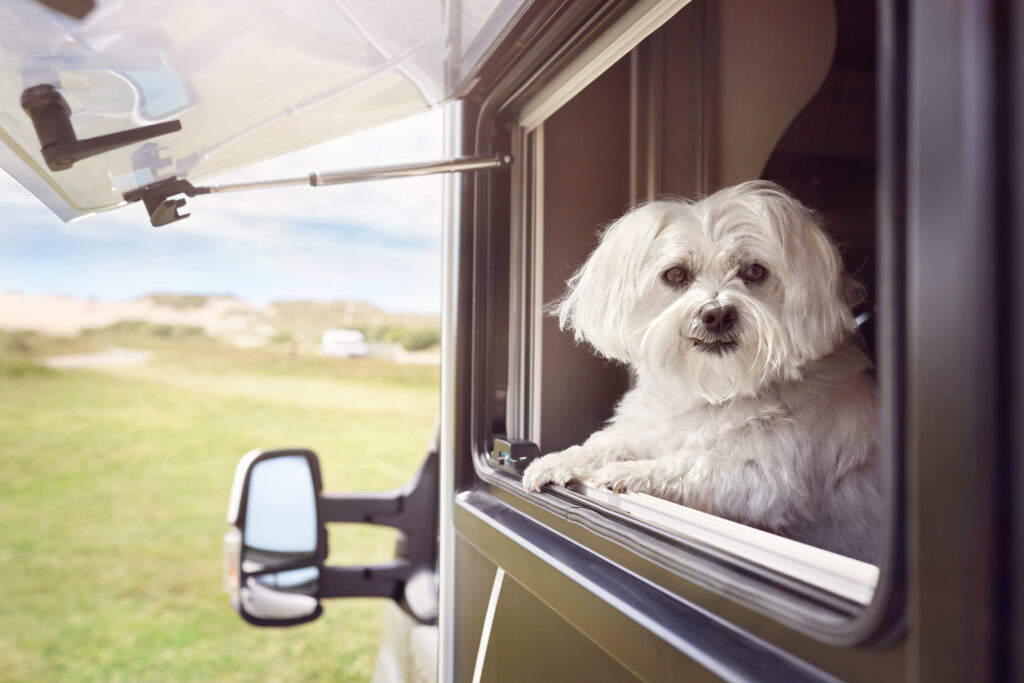
Most couples have dogs. Most of the dogs are little yippy dogs because larger dogs would take up too much space in the RV. The owners walk these little terriers and Yorkipoos, as well as Chihuahuas, on mincing steps around the camp circle. When strange dogs meet about half the time, there is a brief period of angry chaos, with one of the owners insisting, “he’s fine. He’s all bark.” More often than I would have expected, older couples leave their dogs in their trailers, sometimes for many hours — which raises some questions — and the result is that the yippy dogs bark, whine, and even cry from inside the rigs for hours every day.
Most of the people I meet are older, ranging from the late 60s to the 80s. There are two basic types. One group is very well-off, driving expensive rigs whose costs range from $125,000 to $700,000. The man drives, the woman navigates. He’s usually an alpha male. He moves about with confidence in baggy man shorts and sandals. He is proud that he has five slideouts and four television screens, including one that deploys outside. And these travelers, sometimes traveling with their grandchildren, seem to really enjoy sitting outside on camp chairs around a 45-inch LCD outdoor television screen, two miles from Mount Rainier or Mount Rushmore.
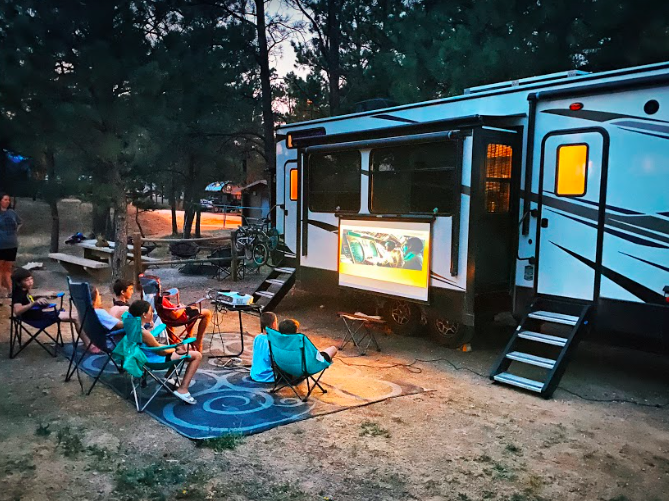
I belong to the live-and-let-live school of RV life — if you want to watch Wheel of Fortune in Yosemite National Park, be my guest. I don’t begrudge people their giant luxury RV buses and fifth wheels. But I don’t envy them. I’ve been in a few now. They are gleaming palaces on wheels, with twin Barcaloungers in one of the slideouts, washer and dryer units, several bathrooms, an entertainment theater, both a kitchen and a kitchenette, plus a range of external amenities like deployable steel porches, high-end grilling units that deploy from the side of the rig, Bose speakers, and — as often as not — a new red Jeep hitched to the back of the rig. I don’t judge this phenomenon, but here’s what I struggle to understand. Why haul a luxury apartment around America at four miles per gallon? What exactly is the purpose of sitting in a recliner watching Jeopardy under the stars of Wyoming? You cannot possibly call this roughing it. Suppose you are slumbering in a Sleep Number king bed, in a unit with double air conditioners (“climate control”), a choice of several bathrooms, and you are cooking ribs on a top-of-the-line grill and spending evenings in your “home theater” watching Adam Sandler movies. Why aren’t you just … well, home? I know people in my hometown — Bismarck, North Dakota — who take their fifth wheels a few weekends per summer to Sibley Park, just four miles south of Bismarck, or Fort Lincoln State Park, fifteen miles away. In a campground, you are much closer to your neighbors in three or four directions than you would be at home, and every rig is made of metal. What’s the appeal?
Those are the luxury seekers.
The other group of older people is more economically marginal. One gets the sense that some of them are on the road because they have no real home to go back to. They are quiet, often walking around the campground for a loop or two, holding hands. They present a meek deportment. They find their slip and quietly set up camp, dine quietly at the picnic table, and by dusk, they are in bed. When I get up at 6:30 a.m., I see them pulling out. They are never loud.
The big commercial campgrounds (think KOA) get the tourist trade. These travelers stop first in the South Dakota Badlands, then at Mount Rushmore, then at Devils Tower, then in Cody, and finally in West Yellowstone. They set up and strike their equipment efficiently. They have a travel agenda, sometimes on a printout. Many have made campground reservations months in advance. They can give you advice on the best RV campgrounds near Tucson or San Diego. They are retired, their children are grown (or estranged), and they are out living the dream.
This is where you will see the rental RVs, such as Cruise America and See USA, among others. These rental units are all inhabited by the Griswolds (of National Lampoon’s Vacation). I always wonder if they are having fun. It all sounded so romantic back in February, but they are now discovering that there are a lot of not-altogether-pleasant steps in driving America in an RV. Each night, you have to level the rig, then hook up water, electricity, cable TV, and a sewer line. These are amenities that one takes for granted back home in civilization — no need to set up your own sewage system on Elm Street — and I can tell you from hard-earned experience that things can go wrong. The RV refrigerators are often persnickety and fickle. The propane tanks go empty when you least expect it. Your heart misses a beat or two every day at the gas pump. Even in the better-made RVs, things tend to tumble about inside as you drive the bucking roads of America. Every evening, when I stop, I begin by putting everything inside back where it belongs. You must engage in sewage management everywhere you go.
In the ma-and-pa RV campgrounds with monthly and even seasonal rates, I lock my door at night. (I suppose I should anyway.) Some of the residents in these sites have been living in their slips for months or even years. Last year in Joliet, Illinois, I parked next to a man who lived in the same RV at the same RV site for 34 years. He could not have been nicer. But in many of the fifth wheels at these sites, there are rough people. By rough, I mean loud, likely to be playing country music at a decibel level that exhibits no concern for others in the campground, drinking beer and crunching the empty cans one by one — often simultaneous with a belch. Lots of shirtless men with a plethora of tattoos. The f-word is never more than a minute or two between repetitions by a range of voices. Also, there is some kind of in-group militancy that I find hard to explain, but the sense I get is that if I looked at them cross-eyed, one of the men in a muscle shirt might wander over to see what the f I’m up to. I’m pretty meek. I lie in bed reading, and at some point — after a particularly loud burst of shouting — I get up and lock the door. It always disappoints me to lock the door. I usually feel a little paranoid.
There is a meth-lab feel to some of the campgrounds I’ve stayed in. One in West Virginia, when I went to see the Beelzebub of Steinbeck authors, my friend Bill Steigerwald, was directly under a giant coal-fired power plant. I kept expecting to see Mark Wahlberg in the next spot, dressing his gunshot wound while holding a tourniquet in his teeth. Many of these people — in their 40s and 50s — seem coarse to me and very much want to be left the f-word alone.
I am probably being too hasty here. There are definitely plenty of people like the ones I am describing. Still, it is true, too, that millions of Americans have lost their jobs, their homes, their spouses, or their faith. Now, they are moving about America in search of work, including temporary jobs, or some new community where they might make one more run at American Dream stability. The national employment numbers look impressive, but it is really important that we remember that millions of people are working two and three jobs, netting less from them all than they did 20 years ago in a single job. We have to recognize that we Americans have built an economic system in which tens of millions of good people live close to the bone and do not receive a living wage — perhaps because the power elite don’t really believe such people are entitled to a living wage. If they did, they would reform the system. I feel affection for the people who are reducing costs and seeking a better future while essentially minding their own business. All I ask of my new temporary neighbors is that they exhibit basic civility; beyond that, it doesn’t matter to me if they prefer Schlitz or Sauvignon Blanc. It’s merely about deportment.
RV campgrounds go quiet at night. When the sun sets, everyone seems to drift inside their rigs. In a hundred-unit site, you might see three or four tepid campfires.
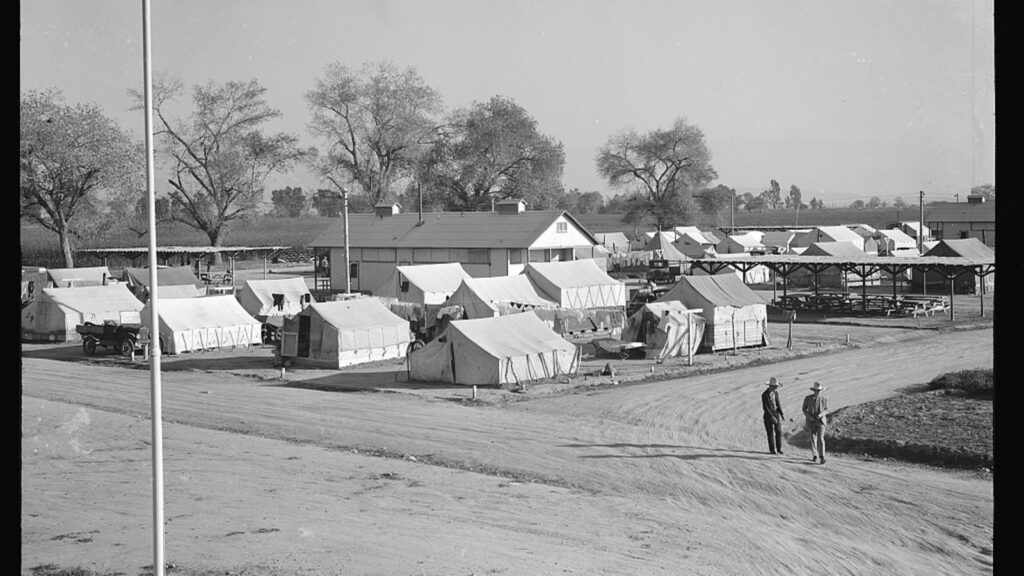
These campgrounds are not like Weedpatch Camp from Steinbeck’s Grapes of Wrath. There is no Saturday night hootenanny. There is no alienated 17-year-old boy from Mississippi who brings out his guitar and harmonica in the evenings or parents watching their teenage daughters like a hawk. There is no Sunday morning church service. People who already know each other gather for a potluck or a grilled burger and seem to have a really good time sitting at a picnic table, complete with a plastic tablecloth to add a hint of domesticity. But this seldom involves strangers who just happened to be strolling by: “Come on in and have a brat. We’ve got plenty.” This isn’t 1934, and there is no Woody Guthrie in Good Sam Clubs. It’s mostly people minding their own business after dark.
On every day that I linger in a campground, sitting outside in my camp chair or at the picnic table, one or two people walk up a little shyly and ask me what Listening to America is. One man asked if I was a Christian evangelist. That appealed to me, but I told him I am merely a humanities scholar retracing the Lewis and Clark expedition. Most people have heard of Lewis and Clark (not all), and even those who know what “Lewis and Clark” signifies make it clear that that is more or less all they know. Maybe they could name Sacagawea or at least recognize her name in a lineup. When I explain that I am crossing the country from Jefferson’s Virginia to the Pacific Coast, they sometimes ask what Jefferson had to do with it. Once in a while, someone will say, “Didn’t Ken Burns …?”
If people linger at my rig and really want to know about Listening to America, I say something like this. Well, I’m just wandering around this country in my Airstream, trying to figure out why we are so stirred up. At that point, approximately 75 percent give me a knowing look or grunt, but a full quarter now say, “I don’t think it’s so stirred up, now.” If they ask for more clarification, I say that as we are approaching our national 250th birthday, my purpose is to be out listening to Americans, trying to get a barometric read on the U.S. at 250 in every region of the country. Just this afternoon, a man came up to inquire about my purposes. When I asked him how things seem in 2025, he said he’s now a man without a political party. He could never vote Democrat, but he cannot vote for today’s Republicans either. Everyone I meet says we all need to be nicer toward one another.

Notice that I have not mentioned the words Trump, Biden, Harris, Pelosi, Rachel, or Tucker. If I let the conversation get even within range of those words, with most people, there is an immediate reversion to caution. They start to edge away. They don’t want to get drawn into a political discussion because “it ain’t worth it,” and for all they know, this busybody in front of them is some pointy-headed liberal sporting for a fight. I never argue out here. I came to listen.
The discussions seldom go very far — the person usually remains standing even if I gesture to the other side of the picnic table — but I listen carefully. I am never the first to end the conversation. I usually give my guests a 5-by-8 two-sided cardboard explanation of what we’re doing at Listening to America and invite them to follow along (metaphorically!). A few, when they approach my rig, say they wondered what this was about and looked it up on the internet.
It’s dusk now. A few of the fancier buses and fifth wheels have groovy accent lights that are blinking on now, usually blue or lavender, and the less wealthy people often have a string of lights they drape over the rear bumper or the awning if they have one. The era of the Tiki lamp appears to be over, alas. Nor have I seen any pink flamingos, but there are plenty of small flags that say things like: “We’re the Hendersons and we’re spending our children’s inheritance.” Or “I’m Barb, he’s Frank, and we’re the Johnsons.” Or “Beware of harmless sleeping attack dog.” Or “It must be 5 o’clock somewhere and we’re willing to drive!”
Across the asphalt, the retro party is still going strong. It’s almost 9 p.m. — I may have to go read them the riot act!!! — and it seems they may be playing cards. However, their laughter is truly satisfying, and it’s clear that they’re having a good time in a peaceful place lined with cottonwood trees. In about half the RVs, I can see evening lights still on. In about half of the half, I see the blue flicker of television.
I’d like to stay here for three or four days — but Lewis and Clark’s keelboat and the pirogues and the encounters with Natives beckon. I’m now only a few days from the Great Plains.
I did my laundry here today, although the change machine was inevitably “out of service.” It was like a doctor’s waiting room. There were a dozen very old and mottled magazines on a rack on the wall. I went into the camp shop to have a look around, maybe to buy some hamburger buns. But the shelves were pretty bare — summer is just starting — so I unhitched and went to town and found the things I needed. In the campground shops, the two things you are sure to find are materials for making s’mores and aluminum tins of Jiffy Pop (“the magic treat, as much fun to make as it is to eat”).
It takes me no more than twenty minutes to break camp in the morning. The more expensive and luxurious the rig, the longer it takes to set up or strike camp. Some people need an hour or more, and older couples are not infrequently bickering. But surely they would at home, too.
I can say this with certainty. Since I obtained this Airstream two years ago and have now hauled it for approximately 30,000 miles around America, I have never once turned on my television, hooked it up to the camp cable system, or even watched a movie. That way, madness lies. I came out here to cut some of my ties to the American Way, to live more deliberately than at home. And what I look forward to most every day is long hours of good reading.
And the open road.