
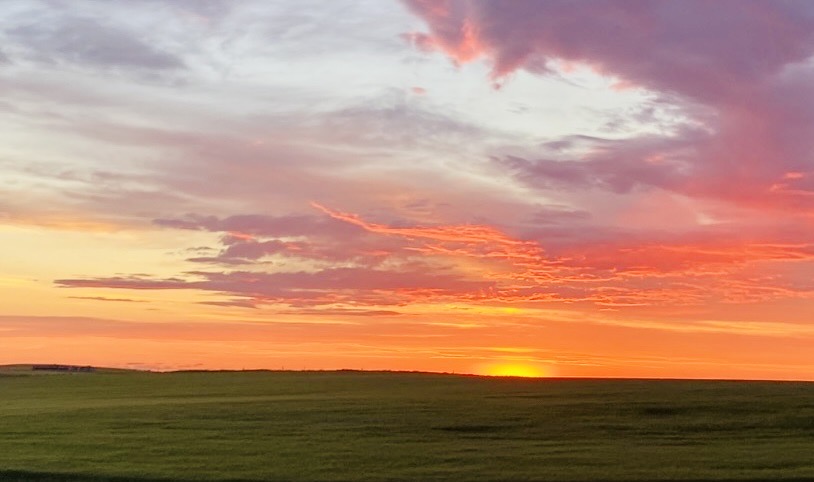
“The undiscovered country from whose bourn
Hamlet – Willam Shakespeare
No traveler returns, puzzles the will…”
BISMARCK, N.D. — I was having a conversation about death and the afterlife with a friend the other day. The question: is death the end — oblivion and complete disintegration — or is it the portal to something else? And if something else, what does that something else entail? She said she wanted to believe there is an afterlife and that we would meet our friends and family there. She’s not sure about any of this, but this is the world she hopes for. I believe that death is the Big Sleep, period, end of consciousness, memory, existence, anything that could be identified with me as a distinct being. At some point in this lovely conversation between trusted friends, I quoted from Hamlet’s “To be or not to be,” arguably the most famous soliloquy in the world: “the undiscovered country from whose bourn no traveler returns.” I suppose I have read this 100 times, maybe more, and have voiced the speech at least half as many. I had never thought about it except as signifying “the other side.” But this time, in east central Montana, on Interstate 94, with the Yellowstone River snaking in and out of our viewshed in graceful s-curves, the ridgelines and the broken hills dusted with snow, I suddenly realized that Shakespeare was writing Hamlet in the great age of Elizabethan exploration. This was the time of Francis Drake and Walter Raleigh, the English settlement at Jamestown, and the mapping and conquest of the Caribbean islands. When Hamlet speaks of the undiscovered country, we should be aware of the Renaissance’s voyages of discovery and exploration; the European sense of bewilderment, wonder, and terror as new worlds forced themselves into their consciousness. Shakespeare lived in a world undergoing breathtaking change.
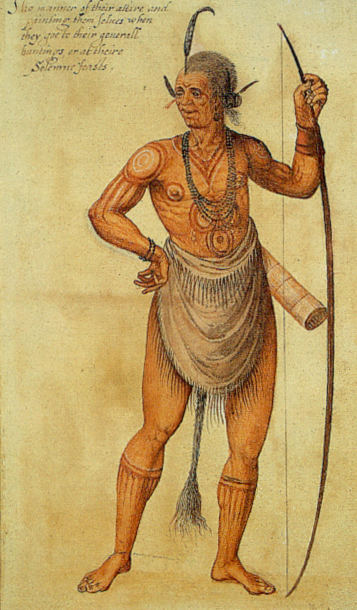
Imagine what Londoners thought when Raleigh’s team brought back two “Indians,” Manteo and Wanchese, from the outer banks of North Carolina. They were Algonquians. They were beings from far away whose appearance was human, but their ways dramatically different. They had not had the opportunity to know of Christ. They knew nothing of metallurgy. Their concepts of property were peculiar. Manteo and Wanchese were among the first natives brought back to the Old World. They and others touched off a 500-year crisis in Western civilization. What to make of these exotics? In some ways, they seemed happier than we were. They lived in cultures that were intriguing and, in some ways, seemingly superior to our own. However much we were attracted to the siren call of their societies, we chose resolutely to cling to our paradigm. The crisis of indigenous cultures continues. Native Americans, cut off from their traditions as they have been made to be, now explore their pre-contact cultures in part to relearn them after a long hiatus.
All that percolated through my mind as we drove along the Eisenhower Defense Highway, which, in eastern Montana, is one of the most beautiful and joy-delivering roads in the world. So now, when I read or recite To Be or Not To Be, I will invariably think not only of the Elizabethan explorers peeking tentatively into a new world but of my drive with a dear friend through Montana on a perfect January day.