
On the 221st anniversary of Meriwether Lewis’ hunting calamity, Clay ponders salt, macrobiotics, and an earlier extended personal journey on the Lewis and Clark Trail.
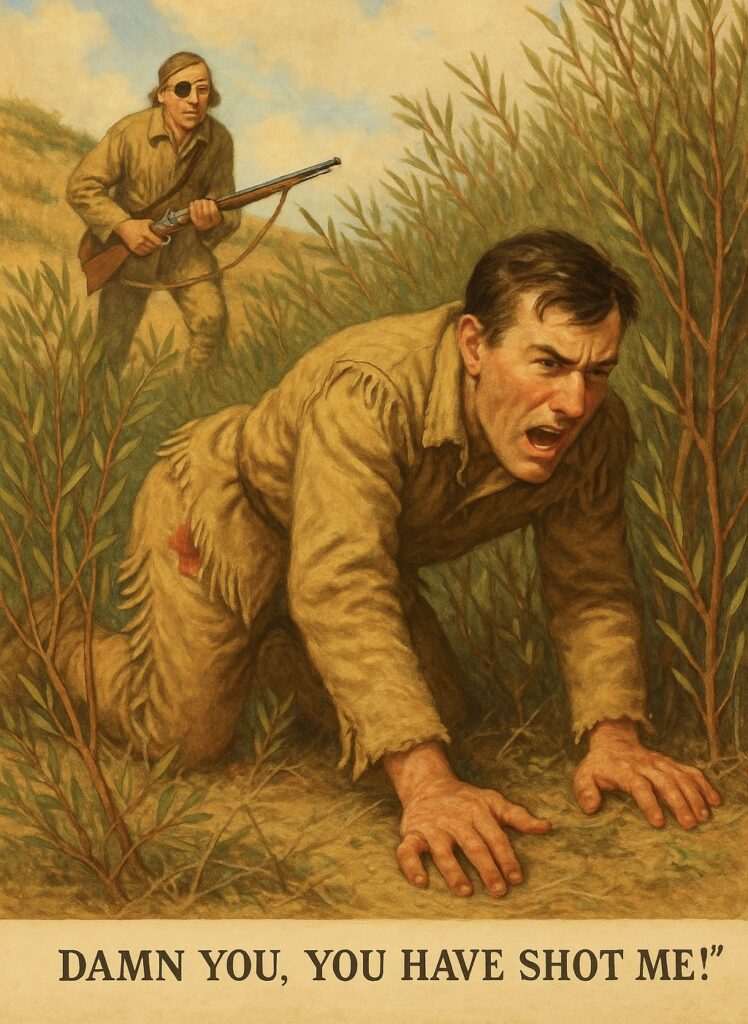
Astoria, Oregon, August 11, 2025 — On this day, 221 years ago, Captain Meriwether Lewis was shot in the buttocks by one of his men. Lewis was hunting for elk in a thicket next to the Missouri River in northwestern North Dakota. For reasons that are hard to fathom, Lewis went hunting with a visually impaired companion, Pierre Cruzatte. By now, they were both wearing the skins of quadrupeds because their cloth clothing had long since been reduced to rags. Cruzatte was blind in one eye and nearsighted in the other. He was the expedition’s principal boatman (“our principal waterman”) and also the expedition’s fiddler. Blind Cruzatte and Lewis, dressed in deerskins, went hunting in a willow thicket. What could go wrong?
Here’s how Lewis tells the story:
“we fired on the Elk I killed one and he wounded another, we reloaded our guns and took different routs through the thick willows in pursuit of the Elk; I was in the act of firing on the Elk a second time when a ball struck my left thye about an inch below my hip joint, missing the bone it passed through the left thye and cut the thickness of the bullet across the hinder part of the right thye; the stroke was very severe; I instantly supposed that Cruzatte had shot me in mistake for an Elk as I was dressed in brown leather and he cannot see very well; under this impression I called out to him damn you, you have shot me, and looked towards the place from whence the ball had come …”
Cruzatte, undoubtedly mortified, explained that he hit what he took to be an elk, but he could not be sure. How would you like to go down in history as the man who shot and killed Captain Lewis on the home stretch?
Lewis was sure. The spent bullet had lodged in his breeches. It did not take a forensics expert to determine it was the bullet from Cruzatte’s rifle.
Lewis realized it was an accident, and he seems not to have punished poor Cruzatte. He was more concerned about the gaping wound in his buttocks. Surely Lewis understood that when you choose to go hunting with a man who cannot distinguish what he’s shooting at, you invite chaos.
Fortunately, the bullet struck neither bone nor artery that could have killed or paralyzed Lewis, but it was a painful and serious flesh wound. It was also humiliating. It was not how Lewis expected to complete his heroic transcontinental mission. A little more than a month later, a fully healed Lewis was able to walk into St. Louis when they landed on September 23, 1806. Meanwhile, he had had to ride down the Missouri River draped face down over a barrel in an expedition canoe, and others — usually Clark — had the honor of changing his bandages and dressing his wounds. In that era of barbaric medical practices, when antisepsis was still unknown, Lewis had more to fear from infection than from the wound per se.
I was thinking about all of this today as I sat on the beach at Seaside, Oregon, where the expedition established a sea salt distillery on January 2, 1806. Desperate for salt to preserve food and garnish their rangy elk supply, the captains sent three men initially — George Gibson, Joseph Field, and William Bratton — with five big kettles (hauled from St. Louis!) to boil seawater 24 hours a day. The salt crews were shifted out a couple of times between January 2 and February 20, 1806. They refined about four bushels of salt. Lewis wrote, “We found it excellent, fine, strong, & white… This is a great treat to myself and most of the party.”
As I pondered the macrobiotics of life on the Lewis and Clark trail (1804–06), I remembered two of the great days of my life in North Dakota. In 2005, I hiked the Little Missouri River for three weeks — alone, of course, because who would want to join me? The Little Missouri originates near Devils Tower in Wyoming and flows north through the Badlands, encompassing all three units of Theodore Roosevelt National Park, as well as the larger 1.2 million-acre Little Missouri National Grasslands. My friend Melanie, the triathlete, dropped me off at Marmarth, North Dakota, and my friend Jim Fuglie said he would meet me for dinner several weeks later at Theodore Roosevelt’s remote Elkhorn Ranch, 35 miles north of Medora, North Dakota. It was the hottest summer in modern North Dakota’s history, with temperatures reaching 105 degrees by noon every day. The journey was a glorious ordeal. Dehydration was a serious problem. It was virtually impossible to get enough water into my system to sustain the hike. I stubbornly refused to quit.
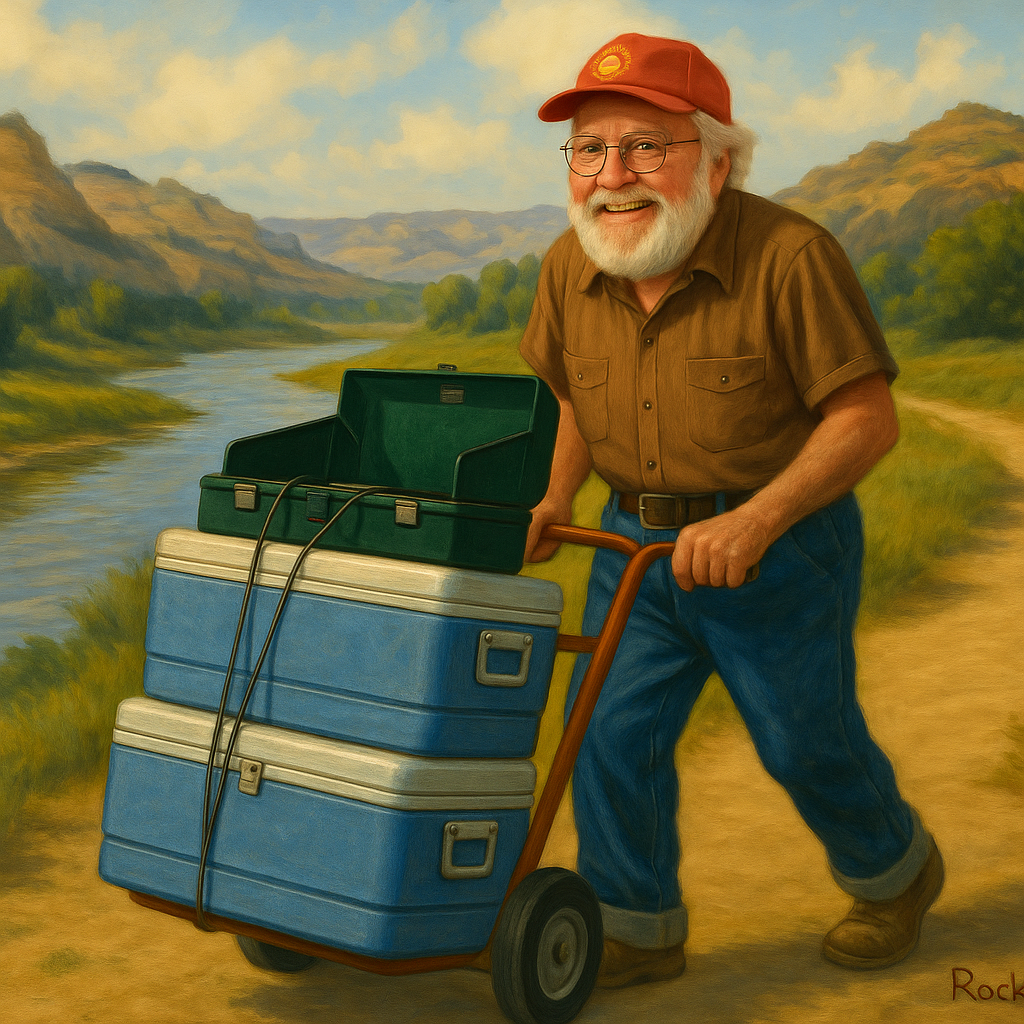
By the time Jim drove out to meet me by pre-arranged schedule, I was as parched as a strip of leather or an orange peel left out on the picnic table for a month. I had reached the Elkhorn site the previous evening, August 9, 2005, and I waited all day on the 10th for Jim to turn up. I read, I dozed, I needed the rest. To get to the site by car, you drive west and then north of Medora along some gravel roads that can be easy to get lost on. When you finally reach the parking lot for the Elkhorn, you have a half-mile hike to the site on a well-maintained trail. About 5 p.m., I heard some distant rumbling. Soon enough, Jim rounded the corner, and I saw that he was hauling a hand truck (a dolly) on which he had placed two large ice chests and secured them with bungee cords. Affixed to the top of this gastronomic treasury were Jim’s old Coleman stove and a couple of frying pans.
I won’t say Jim saved my life, but I have never enjoyed fresh tomatoes more. He brought beautiful beefsteaks, potatoes, fresh fruit, garlic bread, salad, dessert, and a bottle of fine red wine. Plus lemonade and all the cold water I could drink. We had a great feast together. I’d been eating freeze-dried packet food for more than two weeks — Kung Pao Chicken, Beef Stroganoff, Chili Relleno — they all sound more palatable than they are. Now, thanks to Jim’s generosity, I felt like Cleopatra’s younger brother Chip Patra. Jim brought a sleeping bag, and we bedded down within the perimeter of Roosevelt’s 30 by sixty-foot Elkhorn cabin, long since gone.
The stars were magnificent. The coyotes serenaded us. We talked in low tones well into the night and then slept the sleep of the blessed.
In the morning, Jim cooked bacon and eggs before loading up and heading for the parking lot with his empty coolers. I stuffed all my gear into my pack, put on my khaki jacket, and prepared to begin the final three days of my trek. Jim said he would pick me up at Juniper Campground in the north unit of Theodore Roosevelt National Park on Sunday, August 14.
As he was about to lumber the empty ice chests back to his pickup, Jim turned to me and said:
“Hey, today is the first day of elk season in North Dakota. The kind of men who get elk tags don’t usually know the difference between an elk and an elephant, and they tend to shoot at anything large that moves, especially on the first day. Every year they accidentally kill a few cows out here in ranch country. I’m no expert, but isn’t today the day Lewis was shot in the butt by one of his men? Have a great day!”
And off he went.
My friends love to make fun of me. When I started the hike weeks earlier, another dear friend, Patti Perry of Marmarth, served Melanie and me a wonderful dinner before they all took me to my put-in site on the Little Missouri just east of town. It was 8:30 p.m., and the temperature was still 95 degrees. We got out. I shouldered my impossibly heavy pack and prepared to lunge “off the map of the known world.” Melanie was a little teary-eyed (assuming she would never see me again), but Patti and her husband were (as usual) nonchalant. Patti was not really in favor of my hiking the Badlands. Her view was that 4,000 years of human invention and improvement signified that no rational being would hike when he could ride (anything, something) and no reasonable being would ever choose to sleep on the ground. She generally regarded me as an absurdity; as an over-educated man without an ounce of common sense. Once, when I hiked all night (don’t ask) to get back to her house, Patti, the mayor of Marmarth and the president of what she called the Marmarth Hysterical Society, greeted me at her front door as she was leaving to milk her 160 French Alpine goats. She gave me a baleful look and said only this: “There are two types of stupid. There’s stupid and then there’s you.”
At the embarkation point, Gary Perry shook my hand and Patti gave me a gruff perfunctory hug, dragging on her cigarette through the whole sacred farewell ceremony — and then she said, and I quote:
“Because it’s so hot, the rattlesnakes are sloughing their skins early this year. When they shed, they are nearly blind for a time, extremely grumpy, and they tend to strike at anything that moves. Have a great trip.”
I rest my point about the quality of my friends.
Three days after Jim brought his well-chilled cornucopia, I was sitting on the ground under a magnificent cottonwood tree in Juniper Campground when he showed up to take me back to Bismarck. Jim’s been an incredible friend to me for 50 years. In fact, he has, in different ways, propelled my life, education, and career. He’s about as agreeable a man as you are ever likely to meet. We threw my pack in the back. He offered me a cold soda. And he promised, when we got to Bismarck, to make me his celebrated BLT sandwich with tomatoes we would pluck directly off one of his 30 tomato vines. We drove across North Dakota mostly in silence. When we arrived at Killdeer, about halfway to Bismarck, we stopped for gas, and Jim said he needed to use the bathroom.
This is how Jim tells the story: When he came out of the bathroom, he found me standing in front of a 40-foot shelf of Twinkies. Not just Twinkies: Hostess Cupcakes, Snowballs, fruit pies, donuts, Zingers, muffins, fruit rollups, Mrs. Wagner pies, Dip n Dots, cupcakes, carrot cake bites, individually wrapped banana bread slices, and much more. He found me just standing there: mesmerized, dazed, numb, paralyzed. Jim said he had to haul me out of there. There is nothing like a three-week diet of insipid freeze-dried food to blow your mind in the face of what late runaway capitalism can provide. Here, in the middle of nowhere, was this convenience store consisting of about nine long aisles, each one stuffed to the gills with hundreds of different “food” products, none of which a health-conscious person would choose to ingest. I wasn’t hungry. I wasn’t yearning to eat a corn syrup-saturated “pastry” with enough preservative in it to survive a nuclear exchange. I was just amazed at American capitalism. I remember being in communist Yugoslavia decades ago when Josip Tito was still alive. We went into a grocery store. One type of deodorant. One brand of bath soap. A dozen identical cans of generic beans. A few sponges. Some gray handkerchiefs. Two jars of marmalade. Kerosene. Nothing more. But here in America, here in our happy republic, 30 varieties of deodorant and several dozen viciously rival dishwashing liquids. Enough sugary treats to fund Ozempic forever. I stood there in a consumerist shock.

When we arrived in Bismarck, Jim served me — with crisp Cloverdale bacon, fresh lettuce, sourdough bread, and just-plucked tomatoes — the best BLT sandwich of my life.
All those memories cascaded in on me as I walked earlier today in the shallow surf on the beach in Seaside, Oregon. No one shot me in the buttocks. I was overcome with gratitude for all that life has brought me — blessed in friendships, the glorious memories far outweighing my regrets, and an undiminished will to say YES to adventure.
Follow Clay and the LTA Airstream as he retraces the famous Lewis & Clark Trail from 1804-1806 across the continent. This 2025 expedition is a central part of LTA’s big initiative to explore the country and take the pulse of America as it approaches its 250th birthday. Be sure to follow Clay’s adventures here and on Facebook — and subscribe to our newsletter.