
You find Jane Austen fans in the most unexpected places. Though not likely Thomas Jefferson.
My friend David Nicandri of Tumwater, Washington, is a scholar of the history of exploration. He has written a couple of Lewis and Clark books, including the acclaimed River of Promise: Lewis and Clark on the Columbia, and two on Captain James Cook, the greatest explorer of the Age of Enlightenment. Nicandri is one of the last people I would have suspected to be seduced by Jane Austen. But so it is.
Apparently, a year or two ago, he and his wife Chris watched a PBS drama about Austen, which led him to try Pride and Prejudice. (Somehow Nicandri got through the first six decades of his life without encountering Jane Austen.) Now, as he reports, he was “hooked.” He has now read them all, all six novels: Sense and Sensibility, Pride and Prejudice, Emma, Northanger Abbey, Persuasion, and Mansfield Park. Only when he starts reading Austen’s juvenilia will I begin to worry about him.

He has already written two learned articles about Austen and James Cook in a journal called Cook’s Log. Soon, I imagine, he will give up tailgating with his pals at Oregon State football games all around the country and instead attend the annual Jane Austen conference, which I spoke at once long ago. Imagine the tailgate party at a Jane Austen gathering. Horse-drawn carriages, wicker picnic baskets, valets in lavender livery, the minuet at halftime, “aristocrats” working the parking lot in wigs and sedan chairs, Bath buns and clotted cream, plus Cornhole, a game so tedious it must have been invented in the 18th century.
I’m not sure whether I should have lost or gained respect for Nicandri for surrendering so immediately and enthusiastically to the world of Jane Austen. Still, since he’s one of my best friends and she has been one of my favorite novelists for decades, I am delighted to add that to the range of subjects we can debate.
In my lectures, podcasts, and even performances as the third president of the United States, I often say, when talking about the formal manners of the era, “you have to understand that Jefferson basically lived in a Jane Austen novel, where nobody ever says what is really on their minds or in their hearts until it is almost too late.” In a typical Austen novel, a handsome but impoverished young woman meets a somewhat older bachelor who owns extensive property. Though the reader knows from the first chapter that they are going to wind up together at the end, their romance has to get over a number of hurdles (often comic). They nearly lose their chance at happiness because neither one will ever say, “Where are we headed here? Do you love me and, if so, what’s our plan? And why did you appear to be flirting with Fanny?” There is always a character named Fanny.
The Enlightenment was a time of exquisite manners, politeness, formality, and euphemism. Madison and Jefferson — “besties,” we would say today — probably called each other, even when alone, “Mr. Madison,” and “my esteemed friend Mr. Jefferson.” Hard to imagine Jefferson and his wife Martha brushing their teeth side by side in their bathrobes (he flossing), and deciding whether it’s ham and peas or beef and turnips for dinner.
I’m now rereading all of Austen’s novels, not to keep up with Nicandri, who seems to read them in part to comb out the handful of references to the Royal Navy, Captain Cook, exploration, Plymouth, or the “season” at Bath, usually attended by naval officers in search of pleasure (i.e., women with whom to dance and dally, seduce or marry), but because I am hosting a five-day humanities retreat on the novels at Lochsa Lodge west of Missoula in January. But you can bet I’m on alert for any mention of the Royal Navy!
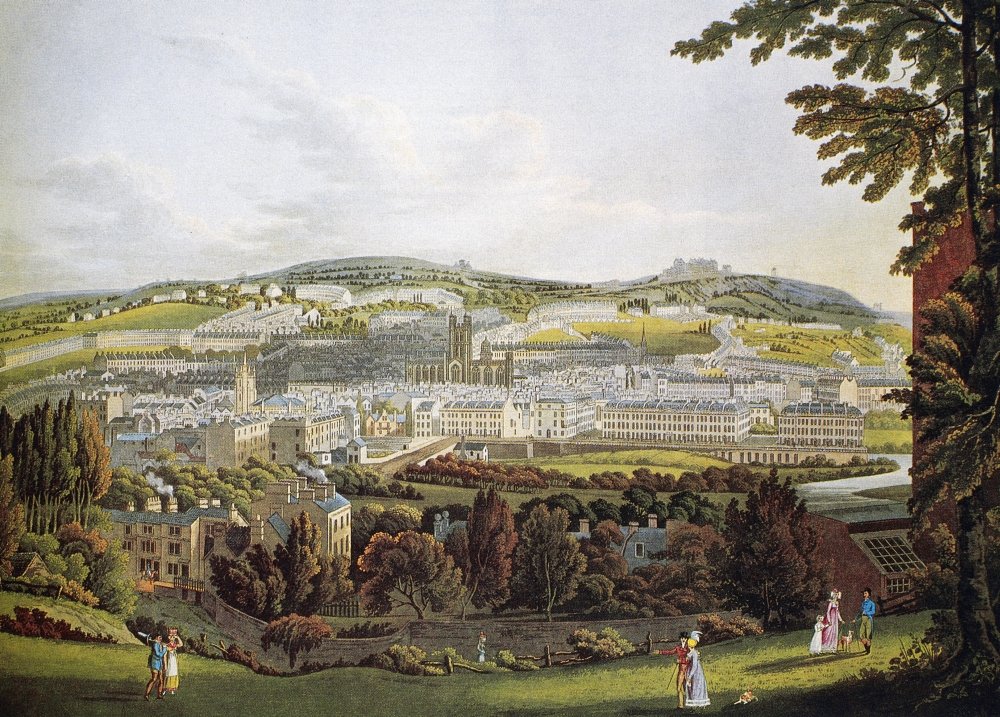
The great English spa at Bath (pronounced Baaahth), dating back to the Roman Empire (Roman baths), appears in four of Austen’s six novels. Privileged people in England before and after Austen’s time (1775-1817) ventured to Bath to “take the waters,” restore their health, dance at the almost nightly balls, parade in gorgeous dress-up clothing and high-piled wigs, and socialize. Bath was a kind of combination of the Lake Chautauqua Institute in upstate New York, and a luxury spa in Sedona.
Jefferson was not a spa sort of person. His view of the good life, expressed in a letter to his daughter Martha (Patsy), May 21, 1787, was, “Determine never to be idle. No person will have occasion to complain of the want of time who never loses any. It is wonderful how much may be done if we are always doing.” It’s hard to imagine him, during his most productive years, spending weeks, or even many days, hanging out at one of America’s spas, Warm Springs, Berkeley Springs, and White Sulfur Springs in Virginia, Saratoga Springs in New York, or Yellow Springs, Pennsylvania. It’s hard to imagine Jefferson queuing up for a lecture on the history of the curtsy at the Pump Room. Jefferson was one of the best-organized and productive individuals in American history. He would not allow a deck of cards at Monticello. Jefferson was “always doing” — making charts, conducting efficiency studies, grafting plants, taking down weather conditions twice a day, planning the next remodeling project at Monticello or Poplar Forest, re-organizing his library, determining the height of the Peaks of Otter, writing an Anglo-Saxon grammar, or comparing vocabularies of Native American languages, with an exhausting set of etceteras in every direction except geology — no time for whist.
Nevertheless
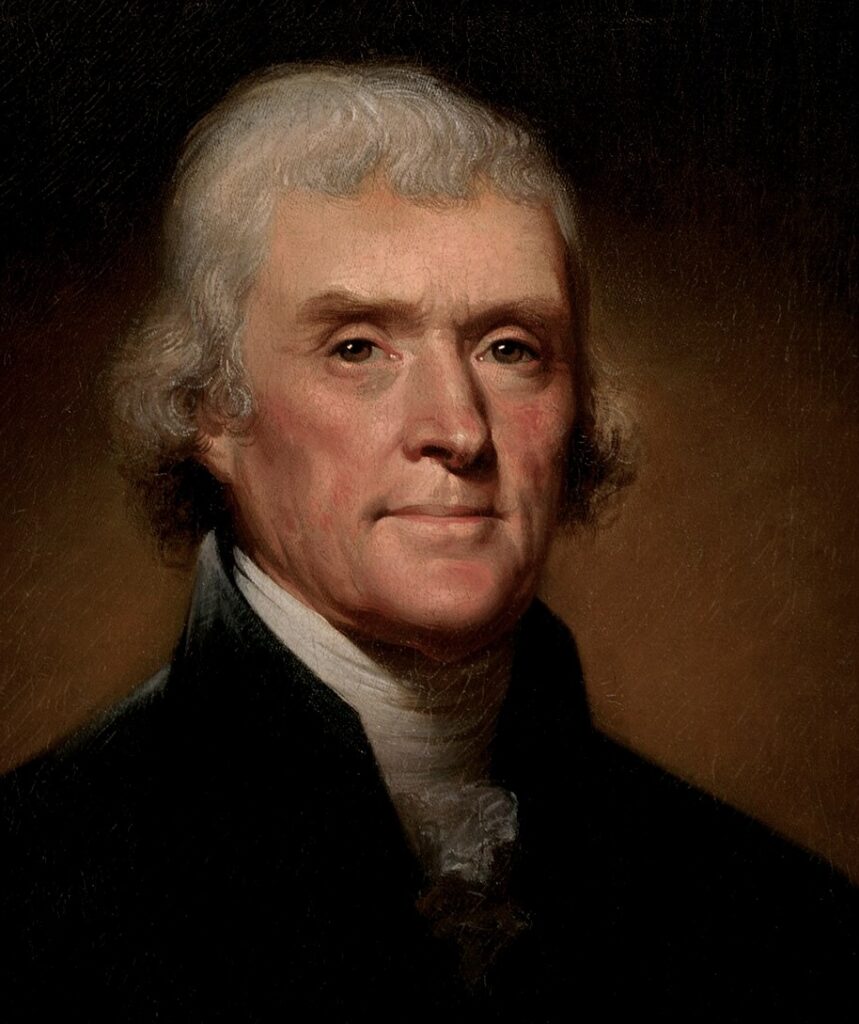
Jefferson “took the waters” twice in his 83-year life, once in France, once in western Virginia. After he dislocated (perhaps broke) his right wrist in some sort of romantic tumble with Maria Cosway in Paris in 1786, he was advised to go to Aix-en-Provence to soothe his pain in its famous mineral pools. The waters of Aix gave him no relief, but he redeemed the experience by taking notes on the baths’ temperature! To make sure the spa visit wasn’t a complete waste of time, Jefferson made Aix just one stop on his famous wine and classical ruins tour of France in 1787 — Dijon, Aix, Marseilles, the Canal du Midi, Bordeaux, the Pont du Gard, and Nimes, the site of what he regarded as the “most precious morsel of antiquity,” the exquisite first-century Roman Maison Carree, which Jefferson used as the template for the new state capitol at Richmond, Virginia.
He made his second spa visit to Warm Springs, Virginia, in the summer of 1818, when he was 75 and suffering from stiff joints. He was out in that part of the state for other reasons, but, concerned for his declining health, as advised by his doctor, he lingered at least three weeks at Warm Springs undergoing a formal treatment program, three 15-minute douches (i.e., soakings) per day. Unfortunately, far from easing his pain, the mineral waters caused his backside to break out in painful boils and what were then called imposthumes. It got so bad that he could only sit on the narrow edge of a chair. He complained that the experience ruined his health and possibly shortened his life. “I am lately returned from the Warm Springs,” he wrote, “with my health entirely prostrated by the use of the waters.” He told former Secretary of War Henry Dearborn that the spa treatments brought him to “death’s door.” Worse perhaps, for Jefferson, he found the entire experience unspeakably boring. “So dull a place, and so distressing an ennui I never before knew.”
The Joy of Reading Jane Austen
“A great obstacle to good education is the inordinate passion prevalent for novels, and the time lost in that reading which should be instructively employed.“
Thomas Jefferson
This week I have been reading Austen’s gothic novel Northanger Abbey (1817) perhaps only for the second or third time since the year (the day, actually) I bought all six of her novels, in splendid orange Penguin paperback editions, at Blackwells Bookstore in Oxford. This was so long ago that my Penguins would by now have cracked spines, if the splendid Penguin paperbacks ever succumbed to such imprecise binding. I’m not embarrassed to confess that if I won the lottery, the first thing I would do is contact Viking Penguin and order a brand-new copy of every book on their publication list (about 2,300 titles).
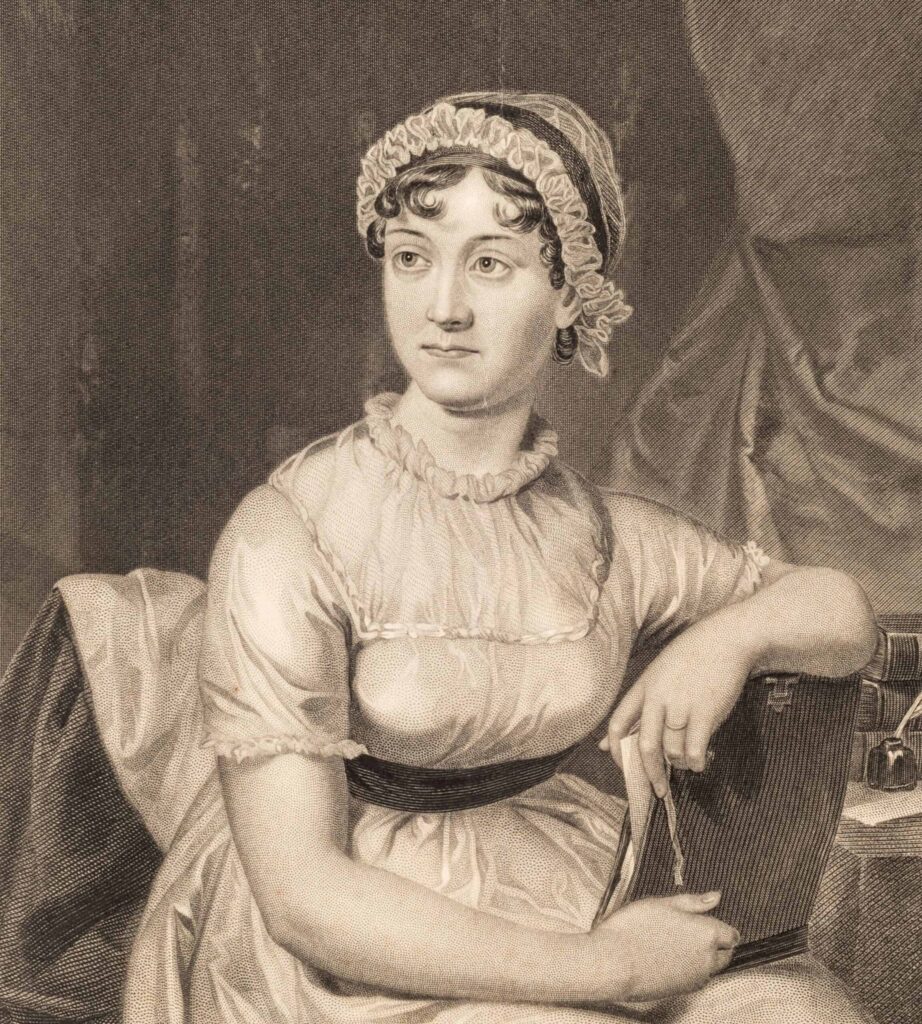
Jane Austen would not have known of Thomas Jefferson. Her few references to the new American republic were not positive. She might arguably have heard of the Declaration of Independence or the Louisiana Purchase. Jefferson visited England as she approached adolescence, but there is no evidence she knew of him. As I was reading Austen’s Gothic novel Northanger Abbey (1817) today, I thought of Jefferson when I came (in chapter five) upon her spirited defense of the novel as a literary genre. Among other things, she writes, “Let us leave it to the Reviewers to abuse such effusions of fancy at their leisure, and over every new novel to talk in threadbare strains of the trash with which the press now groans. … Although our productions have afforded more extensive and unaffected pleasure than those of any other literary corporation [i.e., genre] in the world, no species of composition has been so much decried.” Jefferson was precisely the sort of grumpy critic she was defending the novel against. In a letter to Nathaniel Burwell in 1818, Jefferson issued a diatribe against prose fiction:
“A great obstacle to good education is the inordinate passion prevalent for novels, and the time lost in that reading which should be instructively employed. When this poison infects the mind, it destroys its tone, and revolts it against wholesome reading. Reason and fact, plain and unadorned, are rejected. Nothing can engage attention unless dressed in all the figments of fancy; and nothing so bedecked comes amiss. the result is a bloated imagination, sickly judgment, and disgust towards all the real businesses of life.”
OK, no monthly book club (wine, lasagna, and a smattering of book conversation) for Mr. J.
Jefferson was exceedingly well-read, but in his tens of thousands of letters, he never mentions Jane Austen. In spite of his animadversions (if I may employ a Nicandrism) against the novel, Jefferson greatly admired a handful of classics: Cervantes’ Don Quixote (which he also read in Spanish); Laurence Sterne’s experimental Tristram Shandy; Gulliver’s Travels (Jonathan Swift); and Daniel Defoe’s Robinson Crusoe. He would have frowned on Austen’s obsession with marriageability, dowries, balls, and economic security, but I think he would have admired her sometimes biting social satire. He would have found her discussion of entail and primogeniture (land tenure protocols that severely controlled property inheritance) intriguing, confirming that he was right to convince the House of Delegates in Virginia to abolish both feudal codes (1776, 1785).

Austen’s first novel, Sense and Sensibility (1811), explores many of the same themes as Jefferson’s famous 1786 love letter to Mrs. Cosway, “My Head and My Heart.” Should we govern our lives according to the effusions of the Heart or the dictates of the Head? Austen agrees with Jefferson — the heart should make only occasional and tightly controlled visitations to a sane person’s life. “Do not bite at the bait of pleasure,” he wrote in his letter to Maria Cosway, “till you know there is no hook beneath it.” In the famous dialogue, Jefferson’s Head declares unequivocally, “The art of life is the art of avoiding pain: and he is the best pilot who steers clearest of the rocks and shoals with which it is beset. Pleasure is always before us; but misfortune is at our side: while running after that, this arrests us. The most effectual means of being secure against pain is to retire within ourselves, and to suffice for our own happiness.” That might be a little too strong for Miss Austen. She believed the head should govern one’s choice of a husband or wife — the pragmatics of where the income will come from — but that, under the right circumstances, there is also room for romantic love in these transactions, or at the very least compatibility and mutual esteem.
Austen has a great nose for human hypocrisy and self-love. I wonder what she would have thought had she spent a year at Monticello. There was plenty of drama at Monticello in Jefferson’s late years, and plenty to satirize. Austen does not address slavery much in her novels. Still, such references as exist, together with statements in her private correspondence, indicate that she was in sympathy with the anti-slavery movement in England. What would have bothered her most in Jefferson’s world, I think, is that the sexual exploitation of enslaved women and miscegenation were rampant in states where slavery was still legal. Yet, the white population of those states maintained the polite fiction that those mixed-race children of black women somehow didn’t implicate the men of the slave-owning family. She probably would have found Jefferson a rich subject for satire — his reputation for benevolence conveniently ignoring the fact that he owned hundreds of his fellow human beings, all of whom were presumably “born equal.” I think, however, she would also have found much to admire in Jefferson, particularly the generous and thoughtful grandfather and the lover of English gardens.
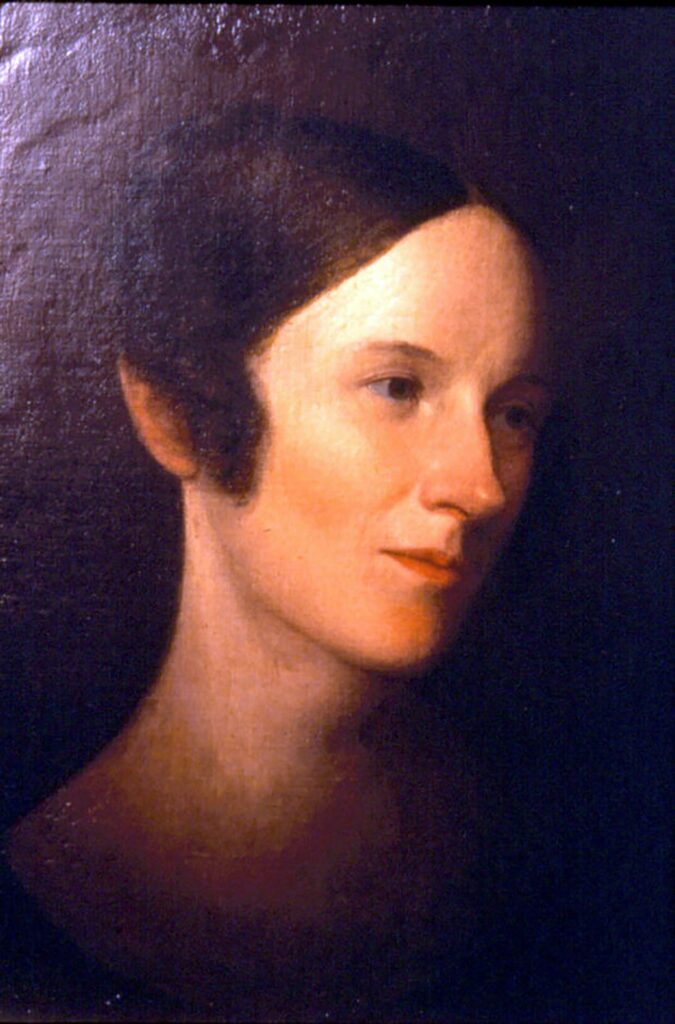
These are questions I will put to my friend Nicandri — if I can pry him away from the Royal Navy. I think talking with him about Austen’s novels will help us both think about Jefferson, and vice versa. That’s the glory of the humanities. They let us contextualize our lives and the questions we wrestle with through the lens of great art and literature. The humanities triangulate human experiences separated by thousands of miles and long spans of time, offering insights we might not reach in any other way. In other words, Jane Austen still has much to teach us in the disillusioned 21st century, even though we no longer take snuff, employ wig makers, dance the minuet, or promenade into the ballroom under the direction of the pompous but infinitely suave Master of Ceremonies Richard “Beau” Nash.
Jefferson’s favorite granddaughter Ellen Randolph (1796-1876) lived in England for a time in 1838, a dozen years after her beloved grandfather’s death. While he was alive, they exchanged letters like characters out of an Austen novel. Ellen was an excellent diarist and prolific letter writer, a young woman with keen (and often wry) observational skills, and she wasn’t afraid to be a little sardonic as she viewed the hypocrisies and artificial manners of her time. I would like to think she knew the novels of Jane Austen. If the timing had been a bit different, she might even have convinced her grandpapa to read Sense and Sensibility.
Jefferson and Jane Austen may not have known of each other, but her defense of the novel reads as if it were crafted as a direct response to Jefferson’s intense critique, written at precisely the same time. Somewhere Jefferson said that, on occasions when he couldn’t fall asleep, he would spend a few minutes devising the plot of a gothic novel he might write. He said this automatically made him drowsy enough to sleep. We would give a great deal to know more about that. We have just this one tantalizing reference to his fantasy of writing a murder mystery. Alas, Jefferson is maddeningly silent about the workings of his heart, his conscience, his imaginative effusions, his doubts and insecurities, and the waywardness of the human spirit.
I’m sure my friend Nicandri knows well that in Jane Austen’s novels, it’s always the louts of the Royal Navy who run off with the silliest but pretty daughter of a respectable family to seek a Las Vegas-style wedding at Gretna Green just across the Scottish border.
Editor’s note: Clay met with LTA book club members last week. They decided to read three books together over the next year, starting with Jane Austen’s Sense and Sensibility (partly to coincide with the new film version of the novel). The next two books will probably be non-fiction. You can learn more about our Listening to America book club here.