
As Clay Jenkinson leads his annual canoe trip through a remote section of the Missouri River, a sudden thunderstorm makes for dramatic challenges.
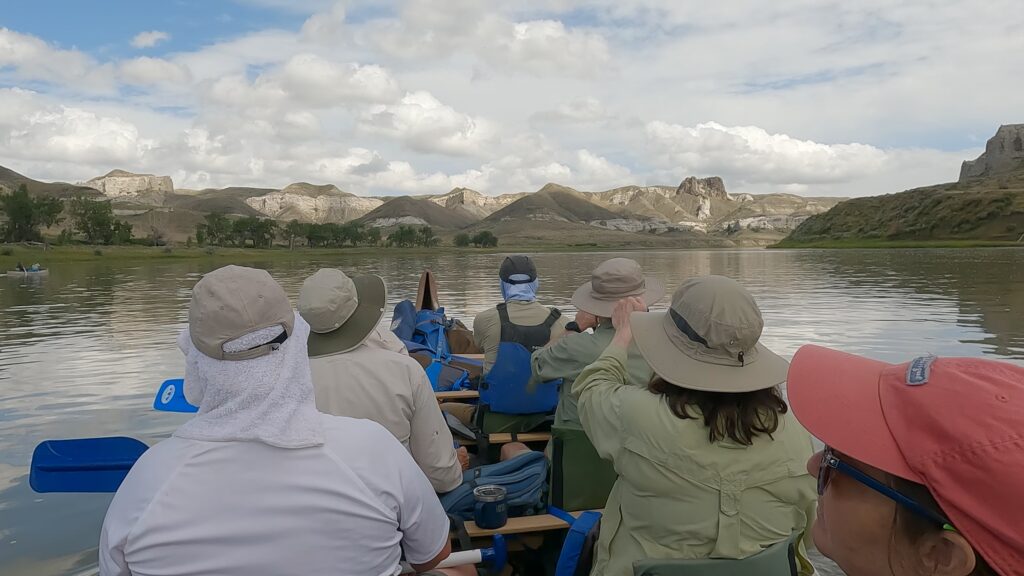
Fort Benton, Montana, July 25, 2025 — Let me begin and end this dispatch by saying that Tuesday, July 22, 2025, was almost certainly the greatest day I have ever spent on the Lewis and Clark trail. Every year, I lead a cultural tour through the White Cliffs section of the Missouri River, southeast of Fort Benton, Montana (3 days, 2 nights), and then along the Lolo Trail in the Bitterroot Mountains, west of Missoula, in northern Idaho. It’s a journey that changes lives.
This year, as usual, 24 of us gathered at the Grand Union Hotel in Fort Benton, Montana, listened to the orientation lectures, received our dry bags, had a great dinner, and (the next morning) rode a yellow school bus to the put-in point, Coal Bank Landing, 40 or so miles east of Fort Benton. The excitement of our group is palpable, along with some typical apprehension.
There are four camping nights on these trips, two on the Missouri and two up on the Lolo Trail in the Bitterroot Mountains. All four are authenticated Lewis and Clark campsites. This dramatically adds to the satisfaction of our guests, allowing them to walk where they walked, canoe where they floated, camp where they set up their camps, and see the Missouri River largely uncompromised by industrialization.
At Eagle Camp at the end of the first day’s float — 14 miles — we hauled our dry bags up to the tents (already set up for us by the crew), regrouped, and then went on the usual end-of-float hike, through a sandstone slot canyon, a hike of about 90 minutes and very limited strenuosity. In some places, the sandstone walls are so close together that we have to turn sideways to slip through. Lewis and Clark never mention this slot canyon, perhaps because after a physically draining day of pressing their flotilla of eight boats (“six small canoes and two large pirogues”) against the 4–6 mph current of the capricious Missouri River, they were not in the mood for a fun side excursion.
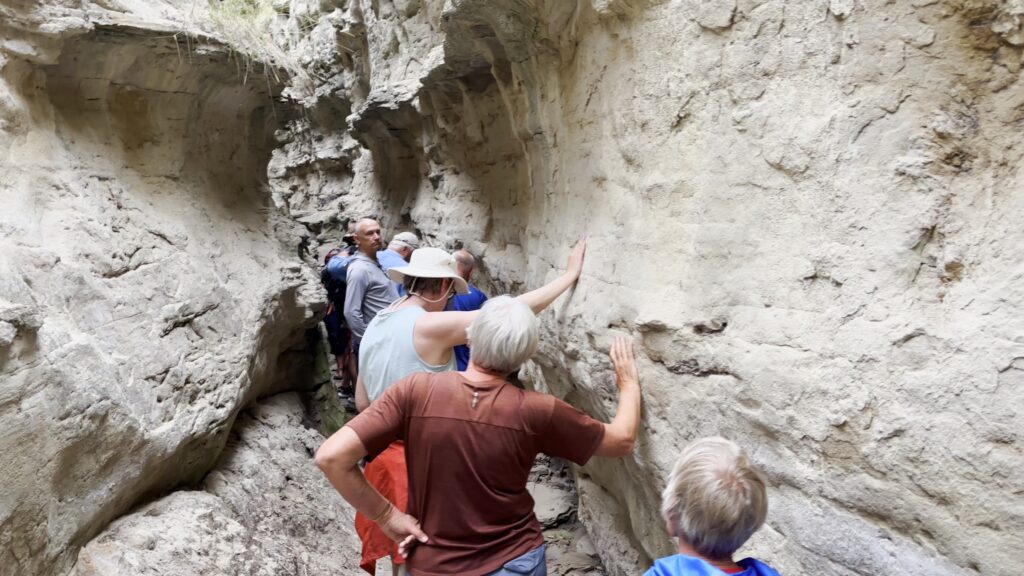
It had been cloudy and drizzling intermittently all day. We were nearing the turnaround point in the hike when the rain started to fall in sheets. This involves climbing up to the ridge over the slot canyon, hiking across to another slot, and then scrambling down over several pretty serious drops to the base of the canyon. Even when conditions are perfect, some people struggle with those drops because you have to trust your feet to find the toeholds, which can be hard to see or locate with your feet.
At this point, an unexpected thundershower drenched everyone almost instantly.
Suddenly, it was raining violently. I noticed that the floor of the canyon was starting to hold water, and the muddy effluent was rising a few inches per minute. It seemed clear to me that we needed to get out of the slot canyon as quickly as possible. Then it began to hail. Most of it was pea-sized, but some of it was the size of marbles, and people were both startled and superficially hurt. What next: locusts? I was able to let myself slide down the worst of the trail drops, tearing my khaki trousers and taking on a very large quantity of mud. Then I helped four or five of our guests down that slot. Most were frightened, but their adrenaline was flowing, and I was able to instruct them about where to plant their feet. One of the guests, a lively, usually fearless woman from central California, actually panicked, by which I mean panicked or, as they put it in the vernacular, “freaked out.” She was spread-eagled, face forward, against the rock face, terrified to move, and by now, a moderately large and powerful waterfall had formed above her head. She looked like a half-drowned water rat.
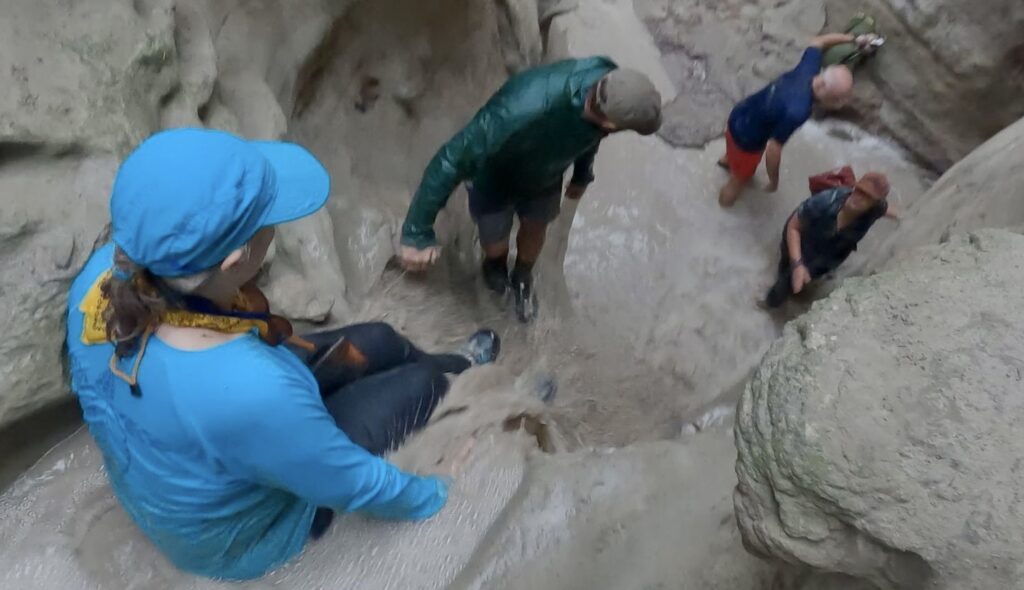
This was only the second time in 25 years that we have experienced a severe thunderstorm on the Missouri River. It was certainly the first time I had ever seen water in the slot canyon.
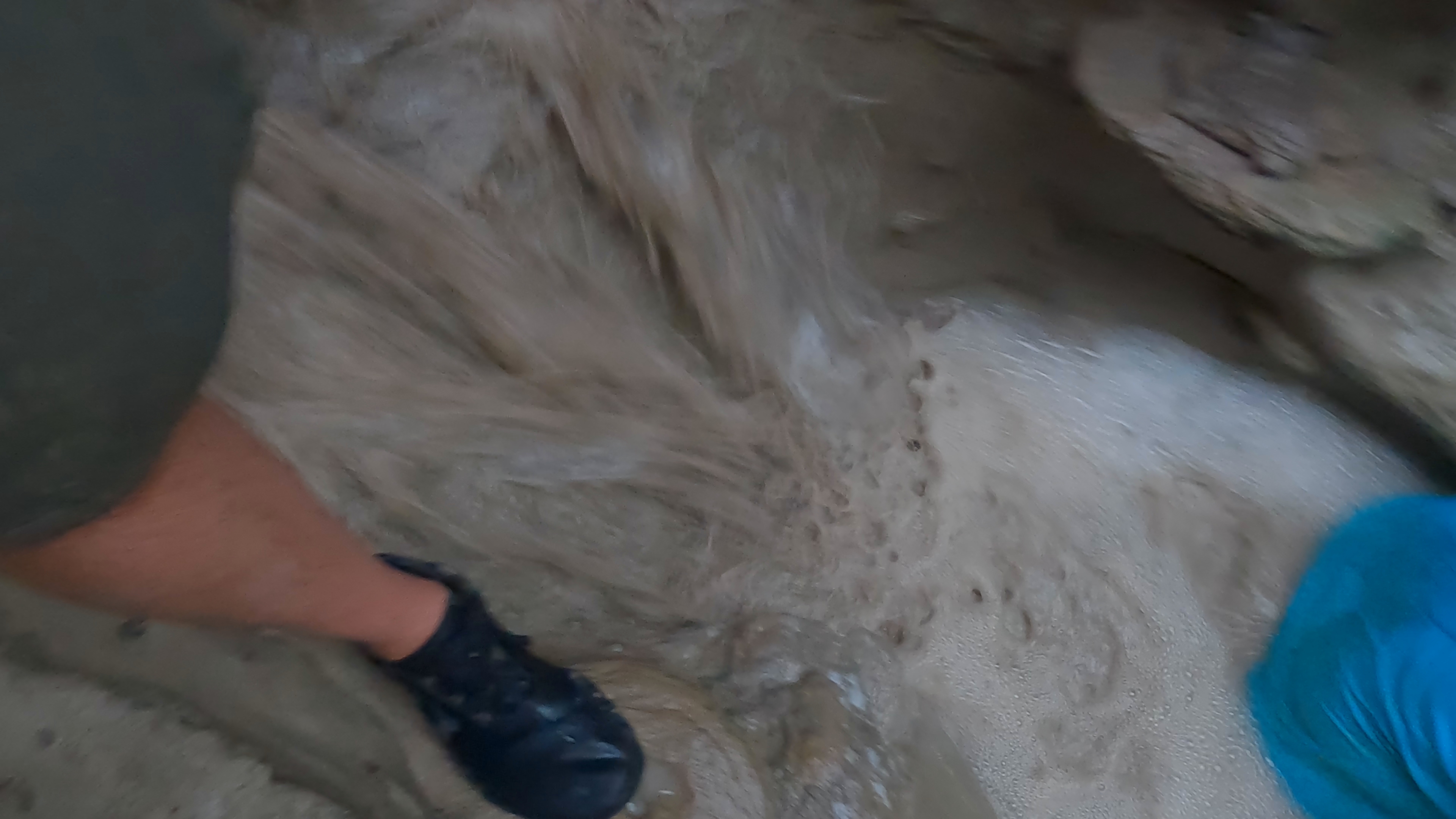
As all of this was unfolding, I became deeply worried about three possibilities. One: Someone would be killed in the flash flood, which was just about swift enough to sweep someone off their feet, and whole sheets of heavy brown water were now cascading over the top of the cliffs — something you might see in the Grand Canyon. I worried that the temporary waterfalls might dump gravel and perhaps even serious rocks onto the heads of our group. Two: Several individuals might be seriously injured. In at least three places, it would be easy to fall five to ten feet into the murky and foaming pools forming below. There were large rocks at the base of each of the drops, but it was now impossible to see them or know where they might be lurking. It would have been easy for someone to break an ankle or trip on one of those submerged rocks and pitch forward into the cliff wall. The people who were successfully over the three drops were sloshing toward the mouth of the canyon at top speed through the muddy rivulet that had formed on what usually is a dry path. There were at least 100 invisible rocks over which one might pitch into the flood. (It turns out that the only injury was sustained by our outfitter guide Jamie, a tough, fearless, seasoned veteran with a very high threshold of pain. She twisted her ankle on one of the submerged rocks while helping others escape the flood. She also lost her cell phone somehow.) Three: I was convinced that even if we all survived the flood (which turned out to be less dramatic than it at first seemed), several couples might announce at dinner that they were leaving the tour — “we never signed up for something like this!” — the minute we got back to Fort Benton.
Everyone survived. There were a few bruises, and the hysterical woman (one of my good friends) had a second bout of freak-out when we lumbered back to camp because the thunder and lightning were crackling all around us. She shouted at me at the top of her lungs: “Where do you want us to go to avoid being killed by the lightning?” As if I knew. I told her to get into her tent, zip it up, and lie down, which she did.
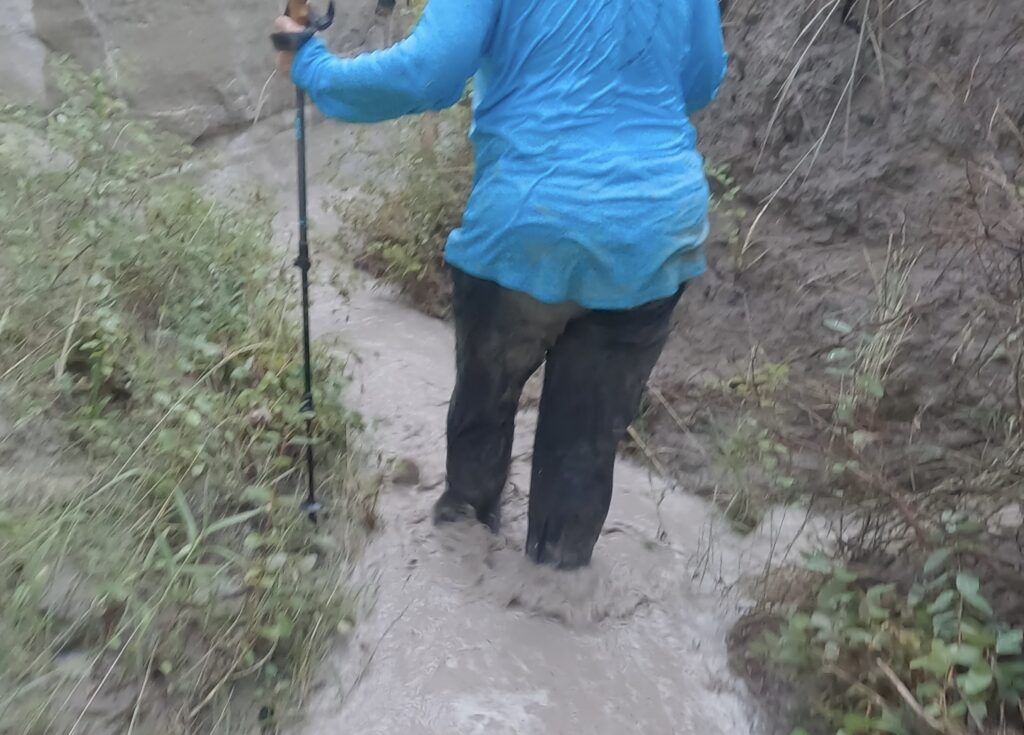
Since then, she has been laughing about her panic attacks, owning them cheerfully, posing for “freak-out” photos, and saying the second one was actually cathartic.
Nobody quit the tour; nobody expressed anger or frustration, and by the next day, everyone had developed a perfect personal narrative — all at least partly true — about the crisis. Still, I’m a bit surprised at the lovely way everyone responded to what was a very serious situation. A few years ago, up in the mountains, we had a similar crisis, and some people have never really gotten over it, though it was something beyond our control.
The day after the flash flood, after a float of 21 miles on the Missouri, we made camp at Slaughter Creek, misnamed by Lewis when he reckoned that a pile of dead bison there were the lingering carcasses of a buffalo jump. Now the little stream is called Arrow Creek. Its mouth — the little green pastoral valley it forms as it meets the Missouri — is one of the most beautiful vistas in the White Cliffs section of the river. The minute we arrived at camp on day two, we all rushed to our tents and pulled out all the soaking gear from our dry bags, spread it out on the sagebrush to dry, and assessed the damage from the previous day’s deluge.
We had a second thunderstorm that evening, but it passed in 35 minutes. The sun came out. The light was absolutely exquisite. People drank good wine — copiously.
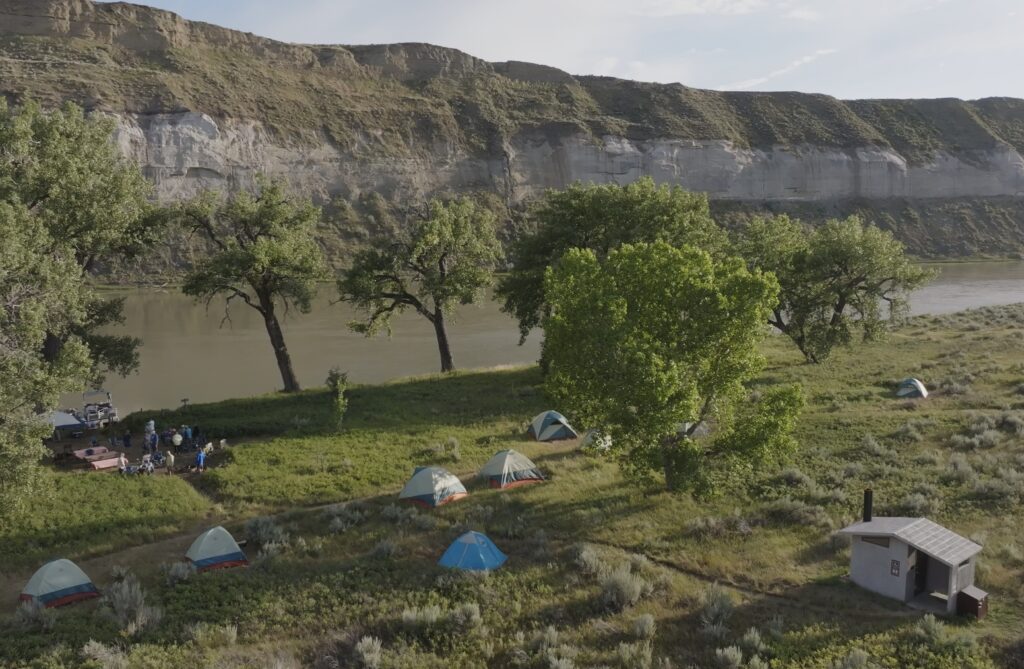
On the third morning, I was invited to visit the other group camping at Slaughter Creek camp: a dozen men canoeing even farther down the Missouri than our guests, with the ostensible leader being a Lewis and Clark adventurer from Livingston, Montana. They offered me breakfast (declined) and asked me to tell the story of the flash flood. They had wisely all hunkered down in their tents through the entire storm. I told the story with as little drama and exaggeration as absolutely necessary. They were green with envy. They cursed their timidity. They so wanted to have braved the flood.
Here’s partly why. They had missed as authentic a Missouri River Lewis and Clark moment imaginable.
Lewis and Clark spent a month portaging around the five great falls of the Missouri River in June and July 1805. This was the first serious impediment to their forward progress in 13 months. The men of the Corps of Discovery had to lug many tons of gear up out of the river bottom and onto the plains to the south of the river. It proved to be an 18.25-mile portage. Backbreaking labor. It was Montana summer hot. The plains were covered with prickly pear cactus, which easily penetrated the thin moccasins (“mockersins”) of the men. Lewis said that the men worked so hard that when the leaders called a halt, the men dropped down wherever they happened to be and fell instantly asleep. There were several severe thunderstorms. It hailed. It hailed so violently that some of the men were knocked down by hail the size of tennis balls. Several of the men had concussions. Several bled from their exposed heads. Grizzly bears were so thick around the great falls that they menaced the portage operation. And to top it all off, the expedition’s whiskey supply played out on July 4, 1805! (The men would have to wait more than a year for their next gill of whiskey.)
On June 29, 1805, a flash flood near the Great Falls nearly swept away Charbonneau, Sacagawea, her son Jean Baptiste, York, and William Clark.
Meriwether Lewis described the incident. On that afternoon, Clark “took with him his black man York, Sharbono, and his indian woman [Sacagawea]. on his arrival at the falls he perceived a very black cloud rising in the West which threatened immediate rain; he looked about for a shelter but could find none without being in great danger of being blown into the river … at length about a 1/4 of a mile above the falls he discovered a deep rivene where there were some shelving rocks under which he took shelter near the river with Sharbono and the Indian woman.”
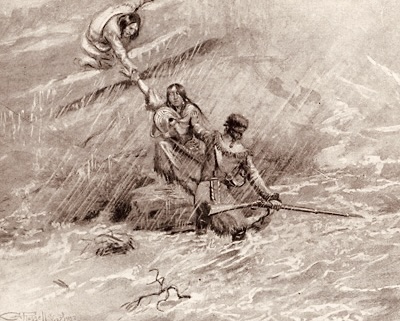
So far, OK. “soon after a most violent torrent of rain decended accomapnyed with hail; the rain appeared to decend in a body and instantly collected in the rivene and came down in a roling torrent with irrisistable force driving rocks mud and everything before it which opposed its passage. Capt. C. fortunately discovered it a moment before it reached them and seizing his gun and shot pouch with his left hand with the right he assisted himself up the steep bluff shoving occasionaly the Indian woman before him who had her child in her arms; Sharbono had the woman by the hand indeavouring to pull her up the hill but was so much frightened that he remained frequently motionless and but for Capt. C. both himself and his [wo]man and child must have perished.”
“so suddon was the rise of the water that before Capt C could reach his gun and begin to ascend the bank it was up to his waist and wet his watch; and he could scarcely ascend faster than it arrose till it had obtained the debth of 15 feet with a current tremendious to behold. one moment longer & it would have swept them into the river just above the great cataract of 87 feet where they must have inevitably perished.”
They all might well have drowned. Fortunately, Clark’s enslaved valet York went in search of the distressed party and hauled them up from the ravine to safety.
Lewis reported that Charbonneau lost his gun, shot pouch, powderhorn, and other items. Clark lost his umbrella (!!), compass, and another scientific instrument. Sacagawea lost “the bier” (probably a cradleboard) in which she “carrys her child and all its cloaths wer swept away as they lay at her feet.”
The following day, the captains sent two men back to the ravine to see what they could recover. They found the compass, but “the other articles were irrecoverably lost.”
That was a real flash flood.
This was one of the most dramatic incidents of the Lewis and Clark expedition. It is especially well known because it involves so many of the principal figures of the journey: Clark, York, Sacagawea, her four-month-old son Jean Baptiste, and her feckless husband Toussaint Charbonneau. Had it been five other men of the expedition — Silas Goodrich, William Werner, Thomas Howard, John Potts, and John Collins — the incident would probably be remembered as a mere footnote.
I repeat that this was not only the greatest day of my decades of experience on the Lewis and Clark trail (since no one was seriously injured), but also one of the great days of my life. Huddled in my tent in a pool of water, shivering from the cold, I lay flat and listened to the pounding of the storm on the tent surface. Suddenly, I found myself laughing with authentic satisfaction.
It doesn’t get better than this.
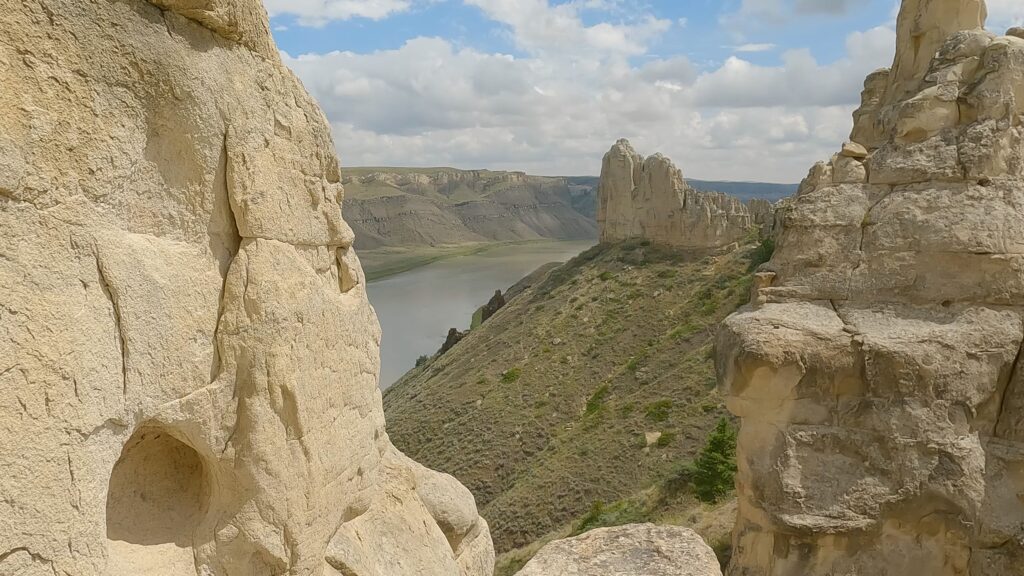
Follow Clay and the LTA Airstream as he retraces the famous Lewis & Clark Trail from 1804-1806 across the continent. This 2025 expedition is a central part of LTA’s big initiative to explore the country and take the pulse of America as it approaches its 250th birthday. Be sure to follow Clay’s adventures here and on Facebook — and subscribe to our newsletter.
