
Sacagawea’s insistence that she be allowed to join the reconnaissance team heading to see the great beached whale is one of the rarest instances in the entire Lewis and Clark journey where we hear her voice.
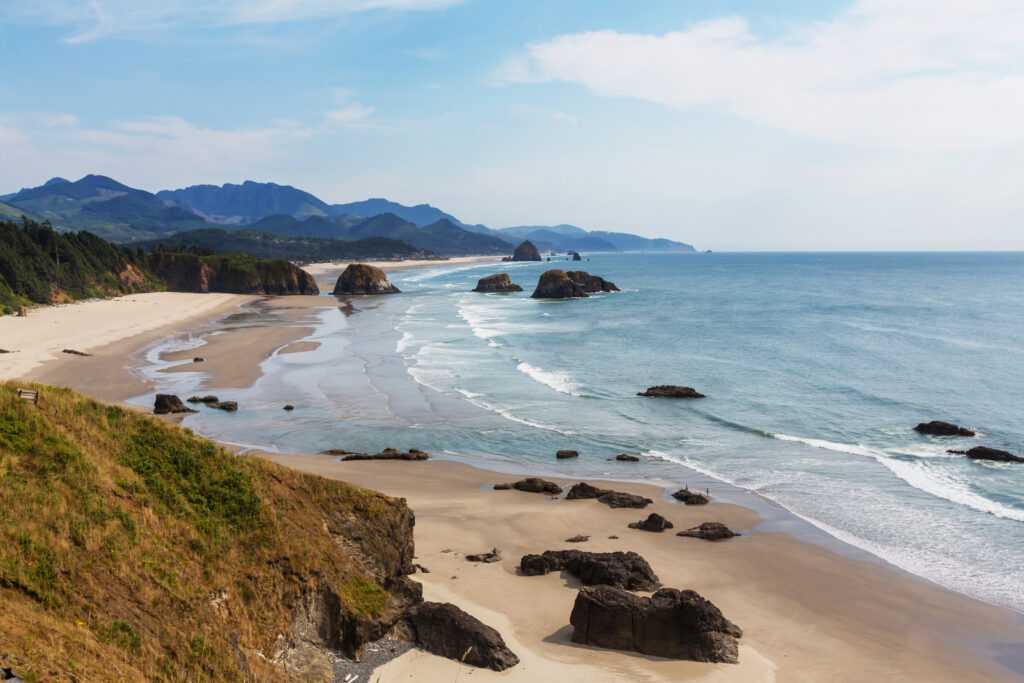
Cannon Beach, Oregon, August 13, 2025 — Well, I have reached the western end of the trail today. To top off my 4 days on the Pacific Coast, I ventured down to Cannon Beach, the site of the Lewis and Clark whale incident of early 1806. During their miserable winter at Fort Clatsop (106 days), Lewis and Clark learned that a whale had washed up on the shore about 20 miles south of the fort. William Clark decided to mount a reconnaissance party to go see the great fish (“mammal,” says Jerry Seinfeld) and, if possible, to harvest some blubber and anything else that might give expedition members a break from the lean and often spoiled elk diet they were enduring, sometimes improved a bit with a side of wapato root. Yum. The whale excursion was partly tourism and partly a quest for a more balanced diet.
The evening before this party of 12 set out for the coast, the Shoshone-Hidatsa woman Sacagawea confronted the captains (undoubtedly by way of translators) to demand that she be permitted to join the whale party.
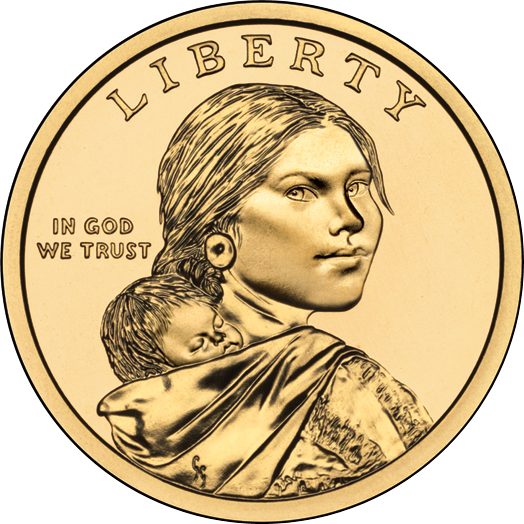
Note: the million words of the Lewis and Clark journals are relatively quiet about Sacagawea. She occupies a place in American legend far greater than in the journals themselves. There are more statues of her than of any other American woman. Almost all that we know about her is conjecture or imaginative projection. “Sacagawea” is a social construct — a Rorschach ink blot in which we see more or less whatever we wish to see. On any given day (there were 862 of them), Sacagawea makes no appearance whatsoever in the journals of the expedition. Keep in mind that the journal keepers were not writing up everything interesting. They were writing the most important things that happened that day from an expeditionary point of view: how many miles they made; what they killed for dinner; what impediments they encountered; whether they met any Native people that day; if anyone got hurt, or mouthed off to the captains, or got lost. Etc. None of the journal keepers stopped to consider what Sacagawea did that day, unless she contributed something to the success of the expedition or unless she was ill (she nearly died at the Great Falls in June 1805).
So when she thrust herself forward at Fort Clatsop on January 5, 1806, and demanded that she be allowed to go to the shore of the Pacific Ocean (which she had not yet seen), and to see the great fish that had washed up there, she got the attention of the expedition leadership. Because of that, she got “written up” for her rare act of assertiveness.
One reason this incident delights me is that it is as close to a direct quotation from Sacagawea as anything in the journals. You can imagine her gesticulating before William Clark (her preferred captain), trying to make sure he understood that her participation in this excursion was not open to debate. She was going! We don’t get many windows into her soul in the journals. For that matter, we don’t get many glimpses into the souls of any member of the expedition. So when a moment like this comes, we fixate on it, because what we know about any member of the Corps of Discovery (33 in the permanent party) is thin gruel.
Here’s how Meriwether Lewis put it: “the Indian woman was very impotunate [sic] to be permited to go, and was therefore indulged; she observed that she had traveled a long way with us to see the great waters, and that now that monstrous fish was also to be seen, she thought it very hard she could not be permitted to see either (she had never yet been to the Ocean).” The journal records not just her demand, but also her reasoning!
Notice that Meriwether Lewis does not refer to her as Sacagawea. She is “the Indian woman.” They have been together for 427 days, since November 4, 1804, when she turned up at the Fort Mandan building site with her “husband” Toussaint Charbonneau. Lewis knows her name, which, admittedly, was probably hard to pronounce, but in his consciousness, she is really not much more than “the Indian woman,” even at this late date. And yet this is “the Indian woman” who played a key role among her birth people in helping the expedition get the horses they needed to cross the Rocky Mountains.
The captains were clearly a little amused that Sacagawea demanded agency at land’s end. Lewis adopts the same slightly icky tone he employs when he occasionally speaks of “tawny damsels” and “Mandan gentlemen.” It amuses him that people he regards as “primitive” are capable of behaving just like us. Clark wrote: “The last evening Shabono and his Indian woman was very impatient to be permitted to go with me, and was therefore indulged.” Clark affectionately called Sacagawea “Janey” from time to time, but here she is just Charbonneau’s “Indian woman.”
So, Sacagawea got to see the great fish (mammal). Just what she thought of the 105-foot monster is not reported, nor what she thought of the Pacific Ocean. Nowadays, from earliest childhood, we are aware of the existence of oceans. We’ve all seen photographs and videos of the world’s oceans. We learn in school that 72 percent of the planet is covered by ocean. There are still many people who have never been to the sea, but virtually no one is now unaware of their existence. Imagine what it must have been like for a hitherto land-locked individual to confront for the first time what Lewis and Clark occasionally described to Natives as “the great stinking lake where the sun sets.”
Here’s what Clark wrote about the expedition’s encounter with the beached whale and the Tillamook people who lived in a nearby village:
“Crossed a Creek 80 yards near 5 Cabins, and proceeded to the place the whale had perished, found only the Skelleton of this monster on the Sand between 2 of the villages of the Kil a mox nation; the Whale was already pillaged of every valuable part by the Kil a mox Inds. in the vecinity of whose village’s it lay on the Strand where the waves and tide had driven up & left it. this Skeleton measured 105 feet. I returned to the village of 5 Cabins on the Creek which I shall call E co-la or whale Creek, found the nativs busily engaged boiling the blubber, which they performed in a large Squar wooden trought by means of hot Stones…”
Even Clark calls the whale a monster.
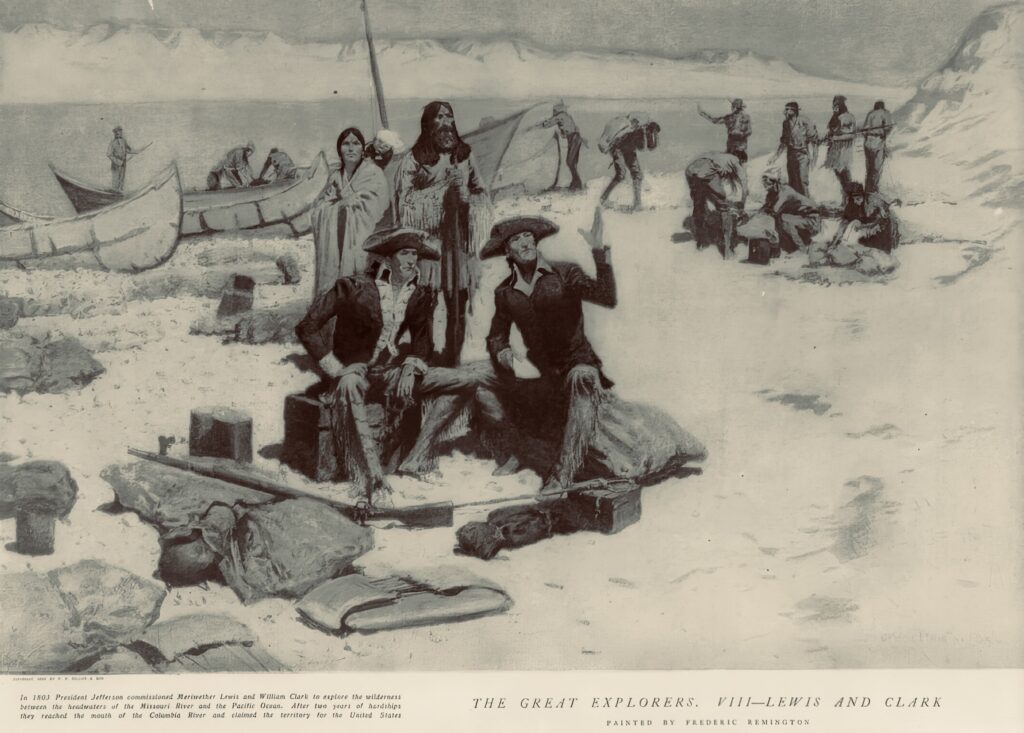
We’d give anything to have the Diary of Sacagawea. Several writers have recently attempted to compose a fictional diary in her voice, with truly dismal results. Unfortunately, we know very little about Sacagawea. We don’t know what she looked like. We don’t know whether she enjoyed the journey or mostly just endured it. We don’t know how she regarded her husband, Charbonneau. We don’t know what she thought of the men of the expedition or its leaders. She is mostly a cipher, what Winston Churchill, in another context, called “a riddle wrapped in a mystery inside an enigma.” We have no choice but to comb the journals for every little clue that might illuminate her personality, her appearance, her character, her responses to events. That’s why this moment is so important. It is not only one of the few moments where Sacagawea emerges from the phalanx of the Corps of Discovery, but it’s also one of the great incidents in the whole transcontinental journey!
This incident is perhaps our best window on Sacagawea. She was curious. She was not passive. She had a will. By this time, she was willing to make her will clear. She was willing to stand up to these white men who were leading her over hill and dale (sometimes the other way around). Thank God the captains didn’t forbid her to join the whale party. We’d really be grumpy about them if they had done so.
On a previous occasion, Captain Lewis wrote about her with breathtaking condescension: “If she has enough to eat and a few trinkets to wear, I believe she would be perfectly content anywhere.” There’s a fundamental lack of empathy.
The great fish (mammal) was not much to look at by the time the Clark party got there on January 8, 1806, after 2 difficult days of travel, including climbing up over Tillamook Head, which Clark called the most strenuous hike of his life. The local Natives had harvested the whale in their waste-nothing, find-a-use-for-everything way. Clark was able to persuade them to sell him 300 pounds of blubber and some whale oil, which his crew then had to lug back to Fort Clatsop by the same difficult route.
Nobody bothered to write up Sacagawea’s response to the ocean or the whale carcass. Even in its stripped-down state, that “monster” whale must have been impressive. Clark measured it at 105 feet long. Today’s cetologists are a little skeptical about Clark’s measurements, but I believe it is always wiser to trust Clark than armchair geographers and biologists (who weren’t there!).
The elusive Sacagawea seems to have died half a dozen years after the Lewis and Clark expedition returned to St. Louis. Who knows what memories she carried and cherished of that enormous journey? I hope the whale incident was one of them. And when she told the story, I hope it was in the way of such narratives: “The captains weren’t going to take me with them, but I stood right up to them and…”
Follow Clay and the LTA Airstream as he retraces the famous Lewis & Clark Trail from 1804-1806 across the continent. This 2025 expedition is a central part of LTA’s big initiative to explore the country and take the pulse of America as it approaches its 250th birthday. Be sure to follow Clay’s adventures here and on Facebook — and subscribe to our newsletter.