
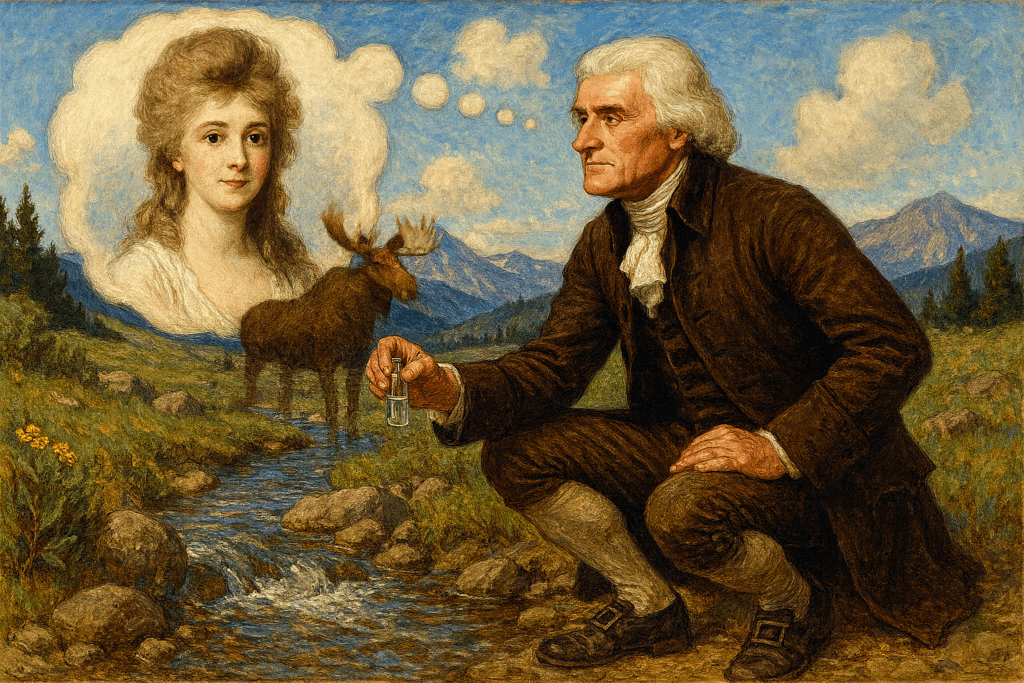
Thomas Jefferson, Meriwether Lewis, and Clay Jenkinson all share a fascination with the origins of rivers.
I’ve been investigating the sources of rivers for a very long time, perhaps because I have been fascinated by rivers all of my life. There are 250,000 rivers in the United States. Only a few of them are iconic: the Colorado, the Ohio, the Mississippi, the Missouri, the Snake, the Yellowstone, the Hudson, the Rio Grande, the James. My personal river is the Little Missouri, located in the North Dakota Badlands and Theodore Roosevelt National Park. Someday I will be strewn there. I prefer a river where I can sit in late summer, but I am not picky.
I’m with Heraclitus, the sixth-century BCE pre-Socratic philosopher: “You can never step into the same river twice.” I’ve floated the White Cliffs section of the Missouri River 25 times now. The three-day canoe trip has been somewhat different each time, and sometimes significantly so. This was the year of the four perfect pelicans.
Source hunting for rivers goes way back to the ancient world. The Greek historian Herodotus (sometimes regarded as the first historian) wrote about the already venerable search for the source of the Nile. That was 430 BCE, just under 3,000 years ago. The source of the Nile was not finally discovered until 1862, when Sir Richard Francis Burton’s comparatively mediocre lieutenant John Speke happened upon the northern outlet of Lake Victoria (which he named and claimed). More recently, it has been shown that the feeder sources of the Nile extend to the Kagera River in Tanzania; however, this was not how the men of the nineteenth century saw such things.
Today I visited one of the true sources of the Missouri River. I’ve been staying in extreme southwestern Montana, not far from Ennis, for a few days. This evening I’m sitting at dusk at the picnic table at my RV park, with a more than quarter moon gracing the mountains to the south and west. It’s cloudy, with a chance of rain, and there was thunder earlier. It’s very still here. So far, no tiki lamps in this campground, and there is no music punctuating the solitude — a perfect end to a great day.
I’ve been to several river sources: the Missouri (Montana), the Columbia (British Columbia), the Thames (central England), the Ohio (Pittsburgh, Pennsylvania), the Colorado (Rocky Mountain National Park, Colorado), the Arkansas (Leadville, Colorado), the Mississippi (northern Minnesota), and the Little Missouri (Oshoto, Wyoming). I feel a physical thrill to stand at the pinpoint on the planet from which a great river begins its journey to the sea. Rivers represent mystery to me. They automatically inspire reflection. Where does the water come from? This may seem obvious until you start to think about it. Where does the water right before your eyes go? If you could dye a cubic centimeter of river water and follow it downstream, would it ever reach the sea? Does a river have consciousness? Is it a living being? Or is it just earth plumbing? I can sit beside (or inside) a river for hours ruminating on these things.
Rethinking Rivers
Before we began to think bioregionally, before we really understood watersheds, it was common to believe that a river had one identifiable source and one unambiguous mouth, between which was a long ribbon of river. Now that we have a more nuanced understanding of how watersheds work, we recognize that most rivers have several source rivulets, like capillaries in the lungs, which soon combine to form a stream or river. Is Lake Itasca in northern Minnesota really the “source” of the Mississippi River? Well, yes and no. Hydrological purists will quibble with that claim; at their most generous, they will say that Lake Itasca is the “nominal source” of the Mississippi, or the “most identifiable source” of the Mississippi, or the “official source” of the Mississippi.
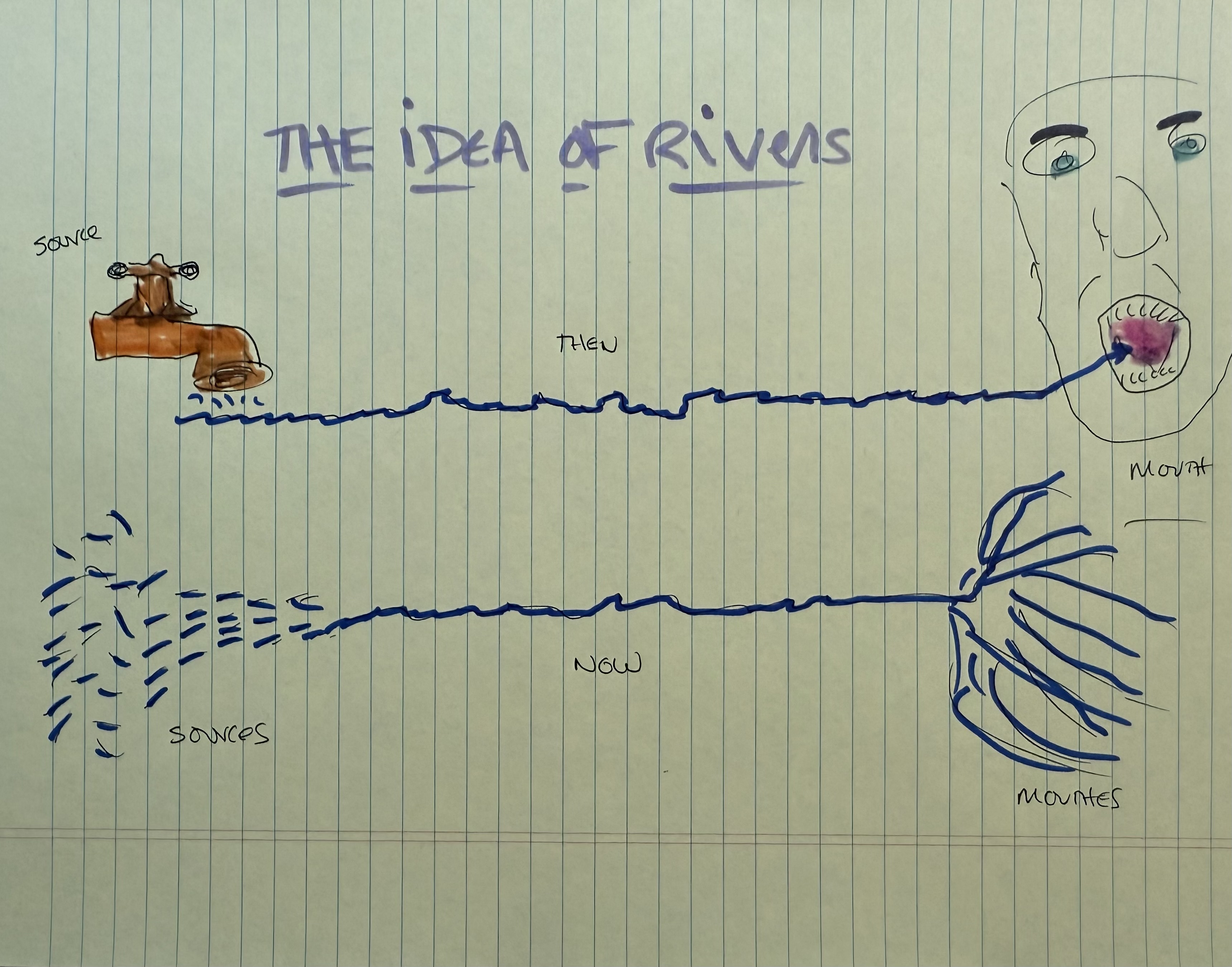
The United States Geological Survey (USGS) doesn’t make things any easier by using arbitrary criteria to determine (really, declare!) the sources of major rivers. No reasonable person can really believe that the confluence of the Allegheny and the Monongahela rivers at Pittsburgh constitutes the source of the Ohio. What’s the source of the Nile, the furthest rivulet tributary of the White Nile (in Tanzania) or the utmost feeder creek of the Blue Nile (Lake Tana in Ethiopia)?
The USGS-declared source of the Missouri River is the confluence of the Madison, the Gallatin, and the Jefferson rivers at Three Forks, Montana, west of Bozeman, east of Butte. But just today I have driven most of the 183-mile Madison River, and not long ago the Gallatin (120 miles), as well as the 83-mile-long Jefferson River, which is fed by the Beaverhead (69 miles) and the Big Hole (153 miles). In my view, if you need a canoe or a bridge to cross it, it’s not the source. How can Three Forks be the source of a river that still has three nearly identical and quite substantial tributaries that extend far beyond their confluence? No rational person can accept the USGS determination, even if Meriwether Lewis himself said at Three Forks (July 1805) that no one of them could any longer justly be called the Missouri proper. Try naming tributaries for presidential administration cabinet members today!
On August 12, 1805, Meriwether Lewis reckoned that he had reached the source of the Missouri River — west of Dillon, Montana, just below Lemhi Pass, which divides waters of the Missouri-Mississippi-Gulf of Mexico from waters of the Salmon-Snake-Columbia-Pacific Ocean. He said it was the realization of “one of those great objects on which my mind has been unalterably fixed for many years.”
I drove about 90 minutes today to reach the “alternative” source of the Missouri, Hell Roaring Creek, located beyond Upper Red Rock Lakes in extreme southern Montana. It’s more than 100 miles from Lemhi Pass. The gravel roads were better than I had remembered. The landscape is so stunning that my friend Russ Eagle said, “It’s only a mountain range away from Yellowstone National Park and equally magnificent. Why isn’t it part of the national park?” Which is a complicated question, but most people of a conservationist bent heartily agree.
I admire the gumption of the ranch family who erected a small sign where Hell Roaring Creek emerges from the mountains and meets the Red Rock Pass road, west of Henrys Lake and a gazillion miles east of Monida, Montana. The sign reads: Hell Roaring Creek the utmost source of the Missouri River 3768 miles to the Atlantic the fourth longest river in the world.

The sign was sponsored (funded) by John and Ann LaRandeau of the Roaring Creek Ranch. I like their pride. “Utmost” — good word. Who will dispute it? I have a new friend named Norm M., who claims to have hiked up to the source of Hell Roaring Creek at Browers Spring, located somewhere in the crotch of Mount Jefferson or Nemesis Peak in the Centennial Range of Montana, Idaho, and Wyoming mountains. I want to doubt him, though I don’t, but I have already begged him to take me there next year.
I was in St. Charles, Missouri, earlier this summer, where the Missouri River is 4,042 feet wide. Today I was in the lonely outback of Montana, just north of America’s first national park (1872), where the Missouri (Hell Roaring Creek) is no more than fifteen feet wide. I sloshed in the lucid stream fully clothed and washed my face and exulted in being at the utmost feeder creek of one of the world’s greatest rivers, the river of the American Serengeti, or what once was American Serengeti. I wanted to, in Lewis’s famous words, “thank [my] god that I had lived to bestride the mighty & heretofore deemed endless Missouri” River. But since I drove to Hell Roaring Creek in a new model GMC pickup, I could hardly claim that I had earned the bestriding moment. Nor has the Missouri been “endless” since August 1805. And I am not sure which god to thank.
Lewis (and Jefferson) at the Source
Meriwether Lewis was Thomas Jefferson’s secretary and protégé. Jefferson was a collector of protégés. Lewis lived with the President in the White House for more than two years before he undertook his 1804–06 transcontinental journey along America’s great rivers: the Ohio, Mississippi, Missouri, Clearwater, Snake, and Columbia. Jefferson’s famous instructions for the Corps of Discovery (dated June 20, 1803) stated:
“The object of your mission is to explore the Missouri river, & such principal stream of it, as, by it’s course & communication with the water of the Pacific ocean may offer the most direct & practicable water communication across this continent, for the purposes of commerce.”
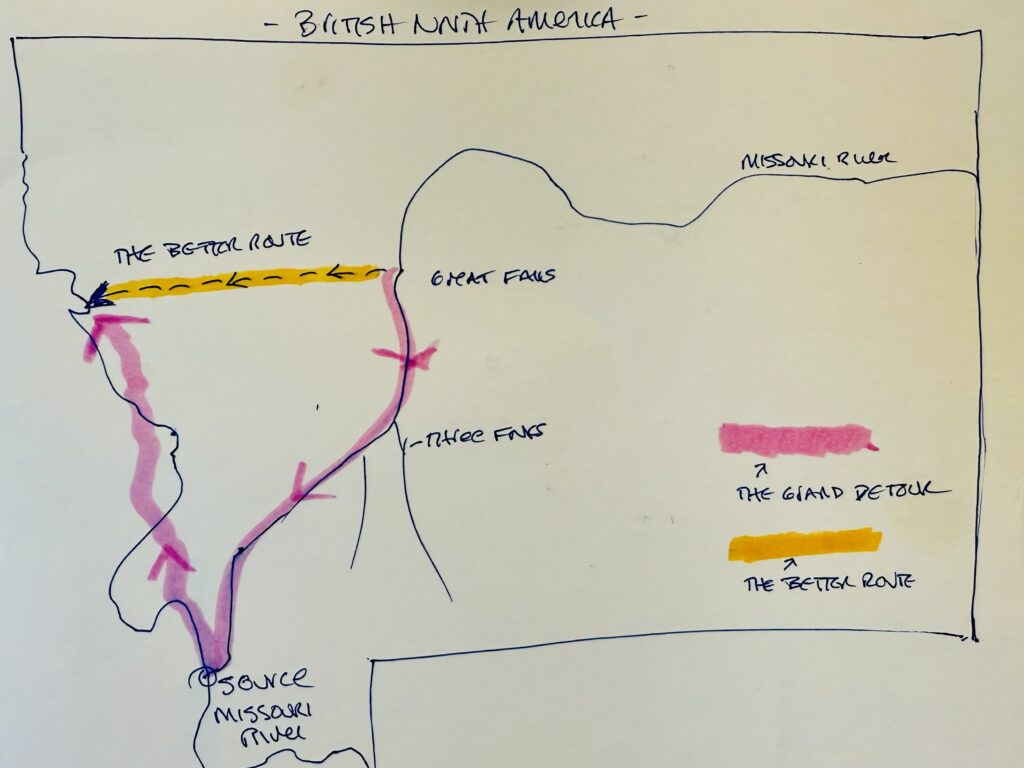
Lewis took this commission seriously, perhaps too seriously. He could have found a more “direct & practicable water communication” between the Missouri and Columbia watersheds if he had ventured due west from the Great Falls, but he was determined to reach the source of the Missouri, come what may. This represented a long and unnecessary detour, but it seems clear to me — after studying Lewis for decades — that he was more interested in drinking from the source of the Missouri than in reaching the Pacific Ocean, although he was determined to accomplish that too.
Thomas Jefferson never saw the Missouri River. He never saw the Mississippi River. Heck, he never saw the Ohio River. In fact, he never traveled farther than 75 miles west of his birthplace in Virginia. That didn’t stop him from purchasing 575 million acres from a French military dictator who never visited North America — both without even consulting the Native Americans whose sovereign lands they were swapping. Repeat: Neither Jefferson (the President of the United States) nor Napoleon Bonaparte (the First Consul of the Republic of France) ever even contemplated bringing the Oto, the Missouri, the Yanktonai, the Lakota, the Arikara, the Mandan, the Hidatsa, the Cheyenne, the Assiniboine, the Crow, the Blackfeet, or the Shoshone to the diplomatic table or asking them which imperial master they would prefer to serve, the one 2,000 miles away or the one 5,000 miles away.
Like his protégé Lewis, Jefferson had a special fascination with the Missouri River (not the Mississippi). In his only book, Notes on the State of Virginia (1785), Jefferson gave a couple of pages to the Missouri River even though he acknowledged that it was not actually in Virginia, not even in “greater Virginia” as Jefferson and his land-hungry compatriots conceived it. But here’s a bit of what he wrote: “The Missouri is, in fact, the principal river, contributing more to the common stream than does the Mississippi, even after its junction with the Illinois.”
In other words, Jefferson believed that the Missouri (starting in Montana) was the main northern branch of the river we call the Mississippi, and what we call the “upper Mississippi,” heading up at Lake Itasca, Minnesota, he regarded as the principal tributary, not the main branch. In fact, hydrologists and river experts agree with Jefferson, in large part because there is a greater continuity of biota if you regard the main branch as the Missouri, rather than the upper Mississippi, whose biota are somewhat distinct from that of the Mississippi below St. Louis.
Notes on the State of Virginia is Jefferson’s classic geographic survey of America (especially Virginia), as well as his blueprint for an American republic characterized by severely limited government, states’ rights, international isolationism, agrarianism, separation of church and state, and periodic revolution (peaceful if possible, bloody if necessary). We learn a great deal about Jefferson’s view of things from Notes on the State of Virginia, particularly his religious views and his paralysis over slavery and race, but he saved his most personal mention of the Missouri River for a letter he wrote to a woman he loved in France, Maria Cosway. Their romance (1786–1789) could not survive her return to Britain in October 1786 with her husband, Richard Cosway (a very tolerant man), and Jefferson’s return to Virginia in November 1789. You know what they say: What happens in Paris…
As she was leaving Paris for Calais and the boat to Dover, Jefferson wrote Mrs. Cosway one of his greatest letters, My Head and My Heart, an eleven-page debate between his romantic heart and his mathematical head about the advisability of falling in love with a woman he could not have for himself. At one point, after inviting Mrs. (and Mr.!) Cosway to cross the Atlantic to paint American landscapes, he wrote:
“I hope in god no circumstance may ever make either seek an asylum from grief! With what sincere sympathy I would open every cell of my composition to receive the effusion of their woes! I would pour my tears into their wounds: and if a drop of balm could be found at the top of the Cordilleras, or at the remotest sources of the Missouri, I would go thither myself to seek and to bring it.”
Translation: if Richard Cosway ever died (a bit of Freudian wishful thinking), Jefferson would soothe Maria Cosway’s grief by traveling from Monticello to the source of the Missouri River at Lemhi Pass (a mere 2,296.3 miles), to get a vial of pure Missouri River water with which to wash away her tears. “Cordillera” means the continental divide. He would go “thither myself to seek and bring it.”
Yeah right, Mr. J.
Thomas Jefferson was not the kind of man to “camp out.” He once said he could not contemplate dressing in the skins of quadrupeds. I so wish Jefferson had written secret instructions to Meriwether Lewis to bring back a vial of water from the source of the Missouri, just in case Richard Cosway expired.
I have been intimately involved with the life and achievement of Thomas Jefferson for four decades or more, and I have ventured to the “remotest sources of the Missouri” a dozen times on his behalf. Each time I have collected a vessel of balm water for Mr. J. or the woman of his enamorment. Deist though he is, I hope he appreciates my aquarian dedication to him. Despite his manifold flaws, I regard Jefferson as the most important American, the author of the American dream, the truest small-r republican in our history. I don’t know how many other Jefferson acolytes have visited the Missouri’s sources on his behalf (with or without collecting water), but I sense that it is zero. Jefferson was a severe rationalist, but occasionally he let his heart worm its way through his calculus into what I like to call “the Jefferson Music.” I love that Jefferson.
So up at Hell Roaring Creek, I collected four bottles of source water, labeled them, and will put them with my collection of other waters when I get back to North Dakota.

When Meriwether Lewis reached what he regarded as the source of the Missouri on August 12, 1805, he wrote one of his finest journal passages:
“at the distance of 4 miles further the road took us to the most distant fountain of the waters of the mighty Missouri insurch of which we have spent so many toilsome days and wristless nights. thus far I had accomplished one of those great objects on which my mind has been unalterably fixed for many years, judge then of the pleasure I felt in allying my thirst with this pure and ice cold water which issues from the base of a low mountain or hill of a gentle ascent for ½ a mile… here I halted a few minutes and rested myself. two miles below McNeal had exultingly stood with a foot on each side of this little rivulet and thanked his god that he had lived to bestride the mighty & heretofore deemed endless Missouri.”
I’m headed there next. And by the way, I feel certain Lewis bestrode the “little rivulet,” too.
Follow Clay and the LTA Airstream as he retraces the famous Lewis & Clark Trail from 1804-1806 across the continent. This 2025 expedition is a central part of LTA’s big initiative to explore the country and take the pulse of America as it approaches its 250th birthday. Be sure to follow Clay’s adventures here and on Facebook — and subscribe to our newsletter.