
Clay and friends are just off four perfect days canoeing remote sections of the Missouri River in central Montana.
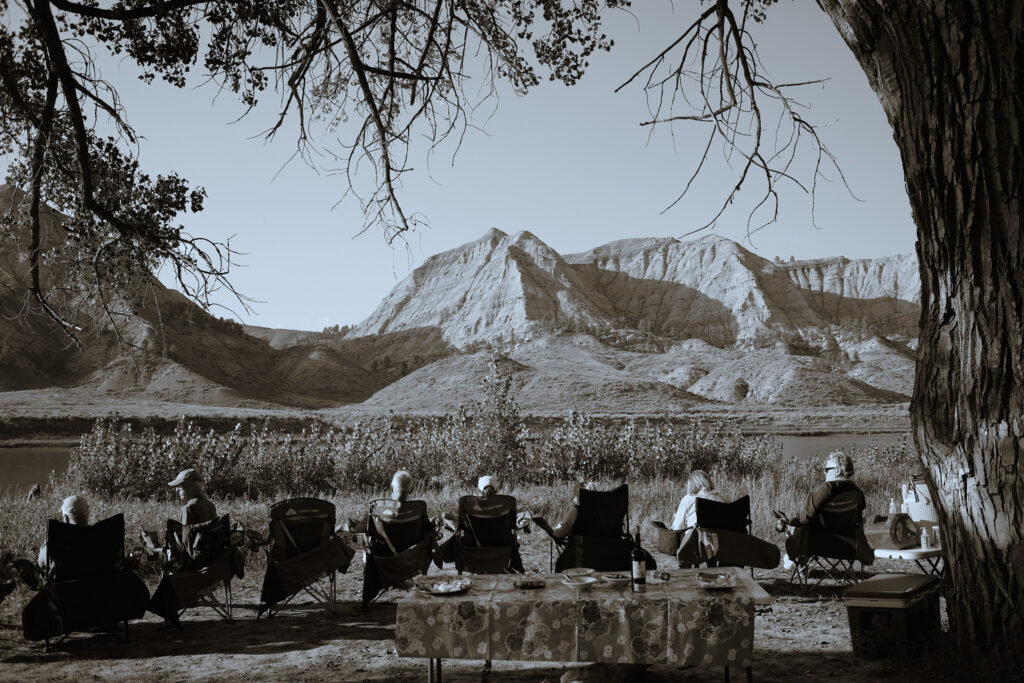
Fort Benton, Montana, September 7, 2025 — We are just in from four perfect — by which I mean perfect — days on the Missouri River. To cap off my extraordinary year of following the Lewis and Clark trail from the Atlantic to the Pacific, I thought it would be fabulous to float a section of the Missouri I have never been on: from the mouth of the Judith River (Judith Landing) to the James Kipp Recreation Area.
I’ve floated sections of the Missouri River in several states, including North Dakota, South Dakota, and mostly Montana. In fact, I’ve taken groups through the famous White Cliffs section of the Missouri 25 times. My outfitter, Wayne Fairchild, has told me for at least 10 years that I must float the next four-day segment, through breaks and badlands country. So, like Fortinbras in Shakespeare’s Hamlet, I “sharked up a list of lawless resolutes,” and put in last Thursday. Most of my compatriots are veterans of several previous adventures with me in the American West.
We floated 61 miles and camped for three nights. The tyrant Wayne made us lug our own dry bags and set up our own tents. Nobody whined. Whining is prohibited. In fact, we took a certain pride in handling our own gear.
The meals were superlative. On the first night, we had steaks hand-chosen by our beef aficionado, Russ Eagle. Second night, excellent pork steaks. Third night, barbecued chicken breasts. Plus fine wine, cold cold beer (just at the right time), hors d’oeuvres, camp coffee, and lunches consisting of cold cuts, bread, cheese, tomatoes, and salad.
Because this was a self-selected group of people who were looking for something more than “just another Lewis and Clark tour,” I asked each person to read or recite a passage from a book, poem, song, or film that somehow expresses how they see life; a window into their outlook. I wasn’t sure this would work — it’s a bit artificial — but I’m certainly glad we did it. As we sat around the fire in camp chairs after dinner and dessert, with the coyotes just beginning to cry their cosmic loneliness, we listened to the selections. Some members of the group memorized their passage, while others read. First up was a cotton farmer from the Texas Panhandle, Barry, who quoted a terrific passage from the film Secondhand Lions. The point was to do the right thing, the noble thing, the life-affirming thing, even when you are pretty sure it is not going to prevail in a fallen world.
And we were off and running. We heard Dylan Thomas’ “Rage, rage, against the dying of the light,” the last sentences of Voltaire’s Candide, a letter from Jefferson to John Adams about the “moral sense,” which Jefferson thought every human being possessed (but must be exercised to operate at peak efficiency). Another veteran read from Jefferson’s letter to his daughter Maria about the ill effects of removing oneself from the world.
One of the group recited several passages from Henry David Thoreau’s Walden, including this short piece:
I learned this, at least, from my experiment, that one advances confidently in the direction of his dreams, and endeavors to live the life he has imagined, he will meet with a success unexpected in common hours. He will put some things behind, will pass an invisible boundary . . . and he will live with the license of a higher order of beings.
It was magical to hear people reveal themselves in this way, around a fire, in a safe space, among friends, a little sheepishly, but with pride and a sense of ownership in the materials they had chosen.
Meanwhile, they really were four perfect days. The Missouri was generous to us. 15 miles the first day, 25 the second, 15 the third day, and just seven miles today. The only wind came on day three in the afternoon, but it was a gentle wind (Russ says three on a scale of 10). Otherwise, the Missouri was placid, glassy, dead calm. We saw herons and mergansers and maybe a dozen bald eagles. The moon rose last night, tangerine red, just as we were settling in for the night. Of all the groups I have taken on the Missouri River in Montana, this was the most harmonious in 25 years. Several couples squabbled and bickered briefly as they found their canoeing rhythm, but nobody had a bad time, not even for an hour or two.
I gave what I call “lecturettes” about Lewis and Clark now and then, and one about the flight of the Nez Perce in 1877, a 1,300-mile odyssey from their homeland in eastern Oregon and Washington over the Bitterroot Mountains, through Yellowstone National Park (then five years old), to the Crow Indian Reservation (where they were not given protection), and finally up toward Grandmother’s Land (Canada: Queen Victoria). But, as everyone knows, they were intercepted 40 miles short of the Canadian border. That’s when Chief Joseph gave the famous speech, the last line of which is, “From where the sun now stands, I will fight no more forever.” We were actually right at Cow Island Crossing in a marvelous copse of cottonwood trees when I gave this little talk.
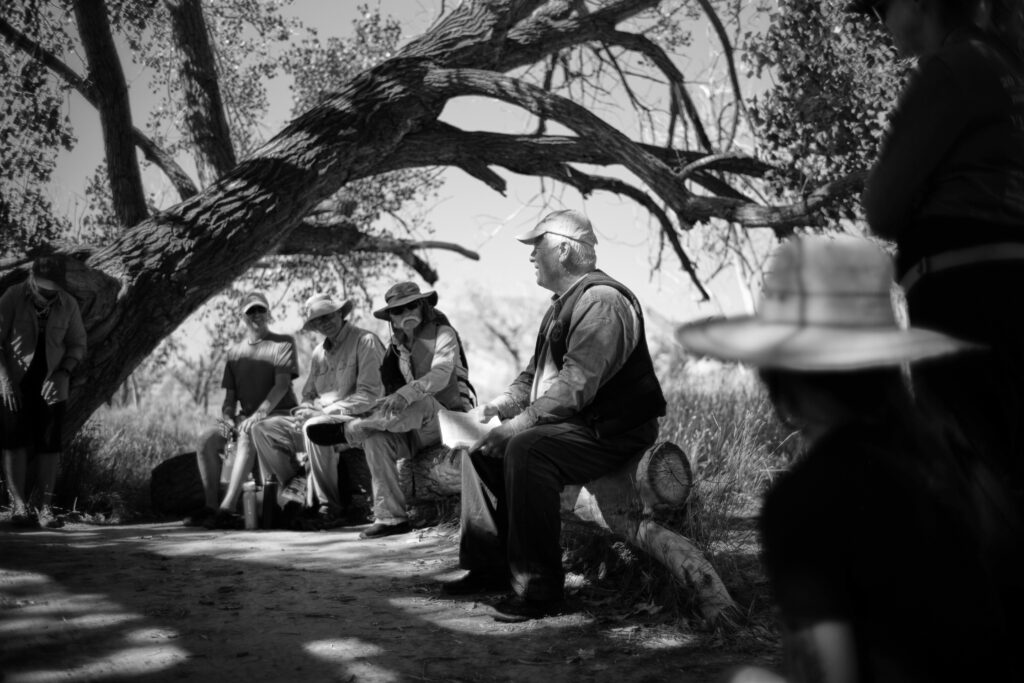
We were all deeply moved by the nobility of Joseph and his band of about 418 older men, children, and women. We all felt that what the U.S. did to this band of desperate refugees back in 1877, noncombatants merely trying to get out of harm’s way, trying to uphold a peace and friendship treaty that dated to the Lewis and Clark expedition in 1806, is one of the most shameful moments in the long, sad history of the frontier conflict. To talk about it there, at Cow Island, was maybe the highlight of the trip for me.
We also stopped where, on May 25–26, 1805, first William Clark and then Meriwether Lewis first glimpsed the Rocky Mountains on their trek to the Pacific. Clark was first up the hill from which the Rockies made their appearance, but Lewis wrote about his own first glimpse so beautifully that historians have tended to give that great moment to Lewis rather than Clark. Lewis wrote:
In the after part of the day I also walked out and ascended the river hills which I found sufficiently fortiegueing. on arriving to the summit one of the highest points in the neighbourhood I thought myself well repaid for any labour; as from this point I beheld the Rocky Mountains for the first time . . . these points of the Rocky Mountains were covered with snow and the sun shone on it in such manner as to give me the most plain and satisfactory view. while I viewed these mountains I felt a secret pleasure in finding myself so near the head of the heretofore conceived boundless Missouri; but when I reflected on the difficulties which this snowey barrier would most probably throw in my way to the Pacific, and the sufferings and hardships of myself and party in them, it in some measure counterballanced the joy I had felt in the first moments in which I gazed on them; but as I have always held it a crime to anticipate evils I will believe it a good comfortable road untill I am compelled to beleive differently. [sic throughout]
It’s autumn now. We were pretty cold the first night. I had to lend one suffering guest a pair of socks for her sleeping bag. In the morning, early, we all hovered around what was left of the campfire, and we badgered the crew to haul the coffee urn into our midst. The days are shorter now. The light is gentler than in July or August. There was a slight feeling of melancholy at the thought that stark, stern winter is coming to the northern Great Plains.
We disembarked from the river in early afternoon, rode in Wayne’s yellow school bus back to Fort Benton. Tonight we have a farewell dinner in the historic Grand Union Hotel. We are elated and joyful but “sufficiently fortiegued.” And tomorrow is the end-of-summer diaspora.
For a range of reasons, most of them relating to my Lewis and Clark immersion tour, this has been one of the best summers of my life.
They are rounding us up for dinner, and I’m advised to end my preliminary report now. But my heart is out there on a bench of the Missouri River, with a few dozen cottonwoods gracing the grassland, with a breeze of 5-9 miles per hour, and thoughtful, adventurous friends talking quietly in little clusters, and the moon rising over what was once American Serengeti. All we need is a few thousand bison grazing and grunting on the other side of the river.
Follow Clay and the LTA Airstream as he retraces the famous Lewis & Clark Trail from 1804-1806 across the continent. This 2025 expedition is a central part of LTA’s big initiative to explore the country and take the pulse of America as it approaches its 250th birthday. Be sure to follow Clay’s adventures here and on Facebook — and subscribe to our newsletter.