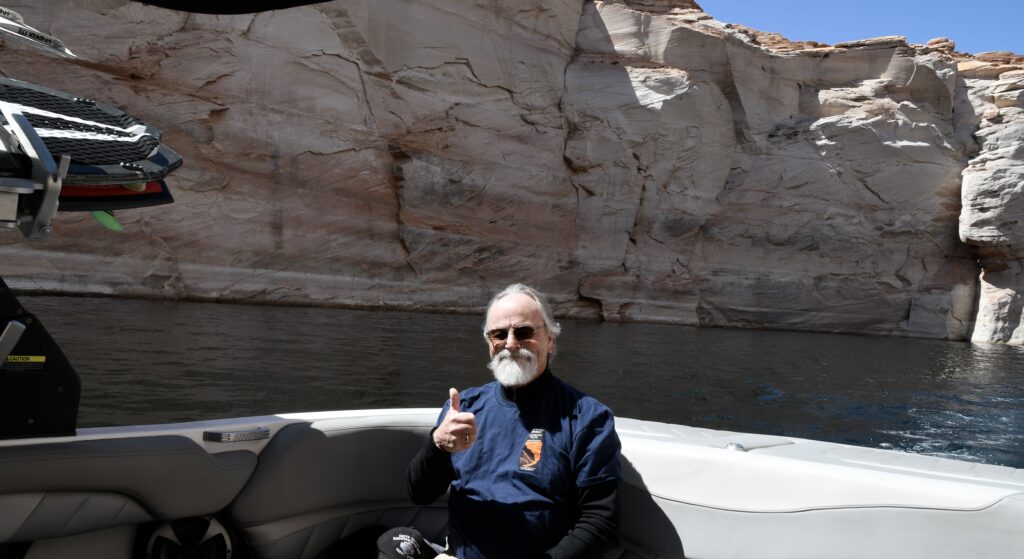
The Listening to America team lost a trusted colleague and dear friend last week. Frank Lister, our chief scout, passed away on October 27, 2026. Frank made us all happy to be alive. He will be profoundly missed.
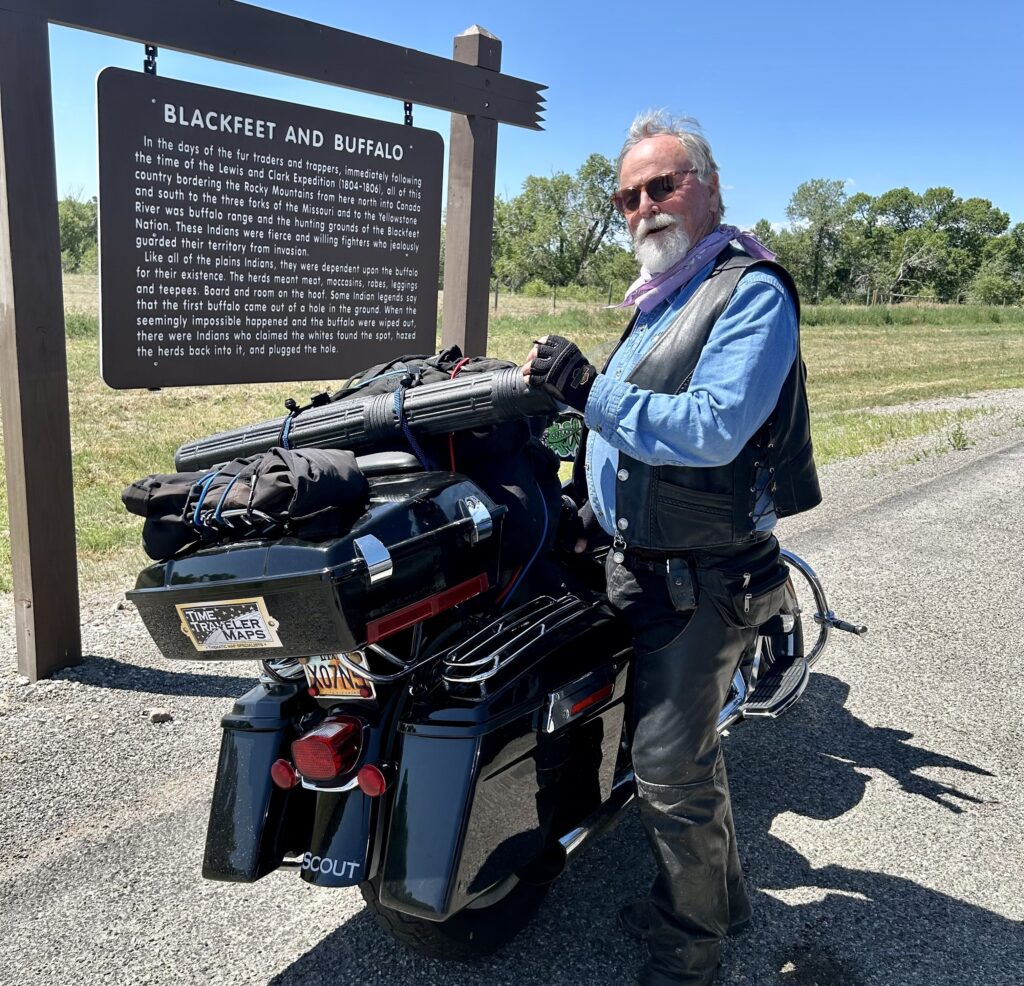
Editor’s Note: Listening to America lost a trusted colleague and dear friend last week. For the last several years, Frank Lister served as chief scout for LTA and was instrumental in planning many of Clay’s Airstream journeys throughout the West. Based in the town of Escalante, in the heart of the Grand Staircase National Monument in Southern Utah, Frank had a long, rich history in the Four Corners region. Frank’s parents were the noted archaeologists Robert and Florence Lister, and Frank spent his early years on archaeological digs in the Southwest and around the world. Over his colorful career, Frank was an adventurer, archaeologist, National Park ranger, tribal advisor, international mountain bike guide, and founder/publisher of the popular Time Traveler Maps series. Frank died on October 27, 2026. The entire LTA team, along with his many friends and family throughout the American West, will miss Frank deeply. Clay wrote the following tribute to Frank Lister.
Frank Lister Had Such a Zany, Variegated, and Unconventional Life That It Always Seemed Too Good To Be True.
Frank has been everywhere, knew everyone or someone who knew everyone, frequented a favorite trading post near Mexican Hat or Farmington, and worked with Tony Hillerman and Louis L’Amour. No matter what subject in the history and culture of the American West might come up, Frank had once worked with a guy whose father had built the dam, a guy who was on the set of John Wayne’s film Stagecoach in Monument Valley, a guy who had a lucrative luxury boat rental business in Page, Utah, a guy who gave Wayne Newton his start. It got to the point where you couldn’t bring up a single thing without Frank saying, “Funny you should say that because in the late 60s …” Now, this may sound like Cliff on Cheers, but Frank had solid, fascinating information about every project he’d ever been a part of, every group with which he had an affiliation. He told his gazillion stories concisely and without flourish. He was very funny. He never boasted. All the stories were told in an “oh, shucks, how lucky was I?” manner. He was just that interesting. He knew the world of horses, Navajo blankets, motorcycles, river runners, and county commissioners, cartography, Western cinema, and Native American studies.
I could never tell whether Frank was a bullshit artist or the real thing; but as time went on, I realized that he had indeed lived many lives, all of them adventurous, some of them abroad. He is best known for his beautiful Time Traveler Maps (Lewis and Clark, John Wesley Powell, Tony Hillerman’s Southwest, the Colorado Plateau, etc.). And as Listening to America’s Scout. The list of Frank’s enterprises, lost causes, and affiliations would fill a passport book.
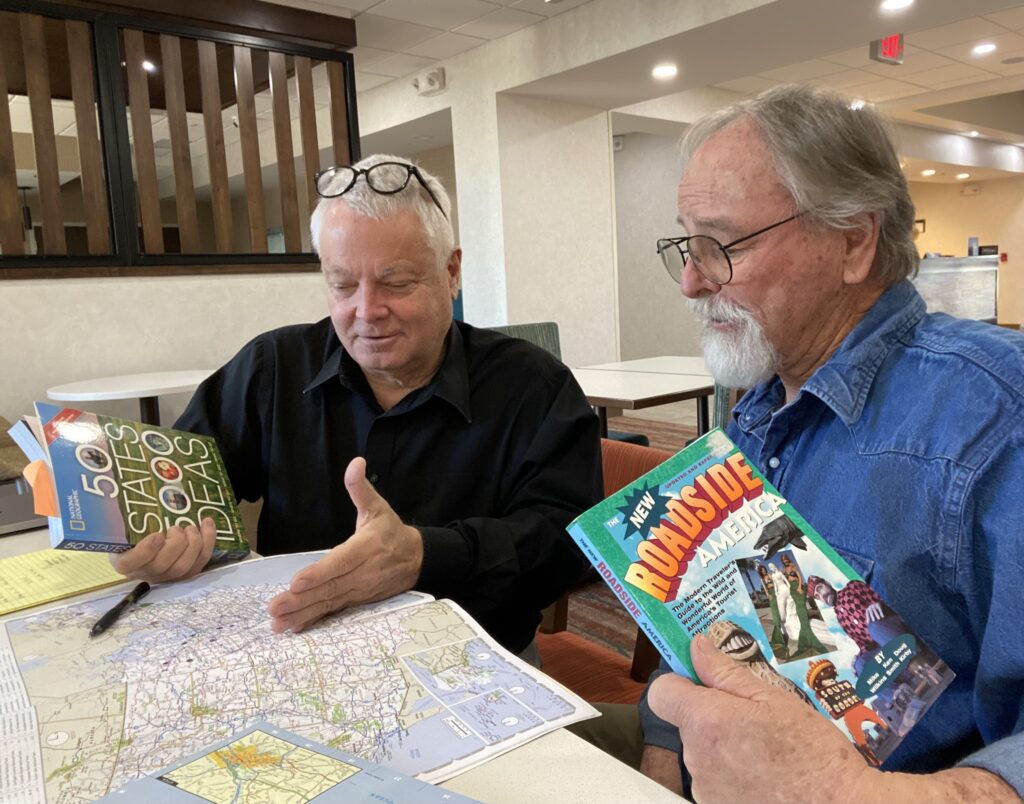
Before my first year of hauling my Airstream trailer around the country, I met with Frank the Scout in a northern suburb of Phoenix to plan the itinerary, the distances, the likely campgrounds, etc. He brought maps. I brought an atlas. I brought my cellphone (with all of its cartographical apps). Frank brought a geometric compass, a measuring tape and a pencil. The evening before, we went to a nice restaurant and talked life rather than shop over a glass or two of beer. Now, with the hotel’s breakfast horde come and gone, we found a large white table and spread out notebooks, maps, RV campground guides, Frank’s maps, and our measuring tools. I’d say, “What if I tried to drive from Billings to Laramie in a single day?” Frank would start using his compass to measure zigs and zags in the road, and I’d consult Google Maps. Frank was unimpressed with what billion-dollar algorithms can do. He added up the road distances and announced his results. They were always spot on, and his weird Luddism made me laugh out loud.
So we were there, coffee’d up, all spread out, trading great road trip stories, when a young mother came in with her two daughters from the pool. They were all wrapped up in hotel blankets on their way to the elevator. The mother was 35 or so, and one daughter was 10, the other 7. The mother and her youngest daughter kept walking, but the 10-year-old studied Frank and me for a few seconds, recognized what strange thing was transpiring, and said, “Old school.”
It was perfect. It was a perfect moment with Frank Lister.
Eventually I learned that Frank’s mastery of the desert Southwest (Edward Abbey country) and his extraordinary network of acquaintances (“Yeah, I worked with him about 30 years ago on the Paradise Valley project. His son is an astronaut.”) did have some limits, somewhere just west of the Mississippi River. He didn’t know as much about Burkina Faso or Florence in the 16th century as he did Blanding and Moab, but he knew what he knew. He had fascinating, colorful, often hilarious stories to tell about people he had known and scrapes he had been in. I have never met anyone who had more contacts in every corner of the Southwest than Frank.
Frank could never be boring.
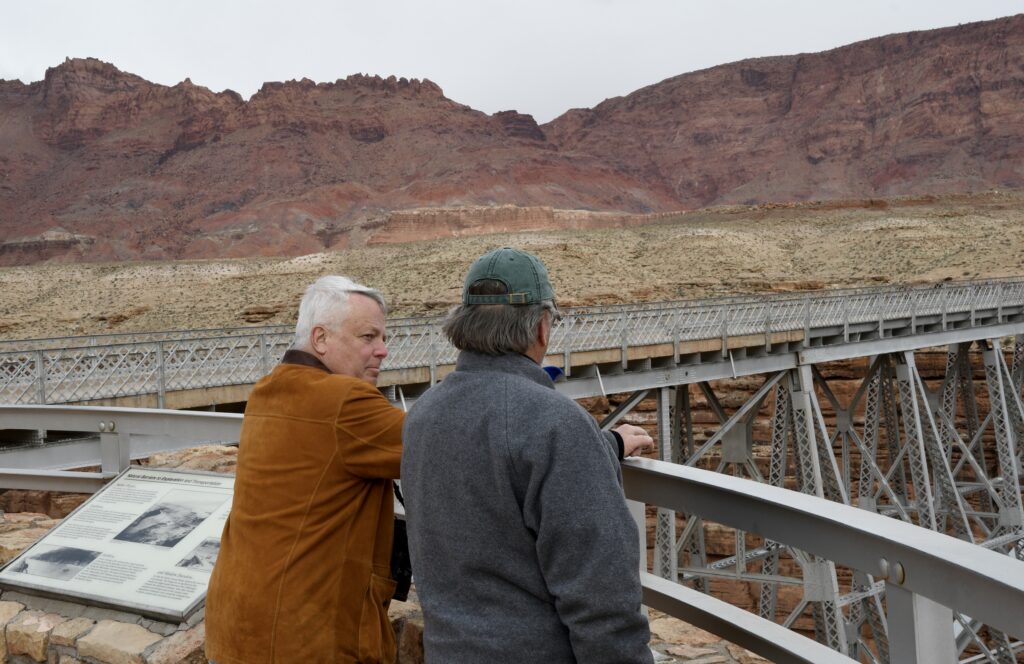
The thing that I admired about Frank the most — actually it flabbergasted me — was his capacity to mosey up to complete strangers and start up a conversation, wherein, of course, they realized they knew other people in common, that this man’s aunt had dated Frank’s younger brother at university (or something) just before the war. There were three of us once at Navajo Bridge, that fabulous steel bridge over the Colorado River downriver from Lee’s Ferry. It’s 470 feet over the Rio Colorado, and though it was built with steel, it looks a little flimsy over such a trench into the earth. Dennis went into the shop to grab a cup of coffee; I walked back and forth on the bridge taking photographs with several lenses, and Frank just disappeared. When I got back to the side of the bridge where we were parked, Frank was leaning over a strut, talking to a guy whose father he knew (truly), who was now officially counting young condors on or near the bridge. Frank came back after a 10-minute conversation with a wealth of details about the river, the bridge, the birds, the research project, the state of government funding in the West, and much more, including where we should eat later in Kanab. Something of just this sort happened wherever we went. I’m an introvert, Dennis is a normal human being, and Frank finds instant rapport with every sort of person, no matter where. When I get to an RV campground, I walk the perimeter, maybe exchanging a few sentences with a couple of fellow campers. But take Frank on that walk, and he’ll find a way to get it down to two degrees of separation. Frank is completely disarming. People sense he is going to be fun to spend a few minutes with.
Frank was all upbeat. When our mutual friend Dennis and I would get going about the decline and fall of the American republic, Frank would listen for a minute or so and then check out of the conversation. He was never rude about it, but his mind worked in a different arena. He was as aware of America’s crisis as anyone, but he reckoned it didn’t do much good to linger there. Vote the right way and make your views known if asked, but without drama. Meanwhile, get on with your life.
We had a glorious adventure with Frank in northwestern Montana. Dennis was there. I was there. Frank had ridden his motorcycle all the way from Escalante to Cut Bank (949 miles) to meet us. I’d arranged with my friend Larry Epstein of Cut Bank for us all to go out to the Lewis and Clark “fight site,” where on July 26-27, 1806, Lewis and three of his men got into a skirmish with eight young Piegan Blackfeet men, and wound up killing at least one and probably two of the young Natives. It was one of those Four Wheel Drive adventures: opening and closing fence gates, getting out to check how deep the ruts were, parking on a slope, and walking a mile to the actual site. My friend Jack Gladstone, a Blackfeet songwriter and storyteller, came, too. Sitting on a cottonwood log, the three of us Lewis and Clark scholars discussed the incident from four or five points of view. It was a beautiful, high-blue-sky Montana day, perfect temperature. By the time we got to supper, we were all tired in that most satisfying “long day in the American West” way.
Frank could be cagey. When Dennis and I, plus our mutual friend Dr. Susan Ryan, decided it would be a good idea to hike out to the exact confluence of the Colorado and Green Rivers (five miles each way, some light scrambling), Frank said he had a pesky hangnail. Still, he would be glad to find a good restaurant for our victory meal later. And he did. And he was not sorry he was not on the hike, and though we missed him, one of the things we really liked about Frank was that he knew what he wanted to do and what he did not want to do, and what he wanted to do surprisingly often involved a motor vehicle of two or four wheels.
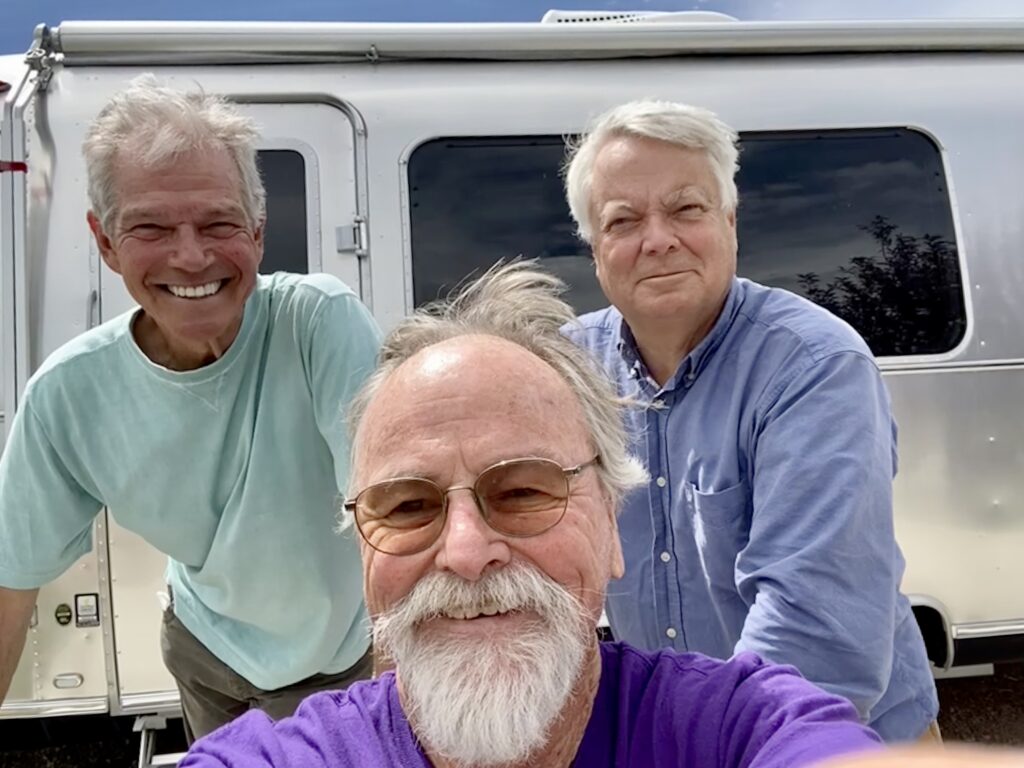
Lest You Regard Frank as a Hero
I loved Frank, but if I may, I need to get something pretty serious off my chest. Forgive me, but I am unable to suppress the pain any longer. A couple of years ago, Dennis, Frank, and I were driving through the Four Corners area, investigating the Western water crisis and listening to all sorts of people talk about the state of things — in the West and in America. The night before, as we were poring over maps at dinner, I said to Dennis and Frank, “I would like to stop at Four Corners tomorrow just for a few minutes. I know you two sophisticates think it’s cheesy and kitschy and that we may as well keep moving to our destination, but I really want to see it. To be this close and fail to stop! That’s un-American. So let’s do the pilgrimage. Is that ok?”
They looked at each other helplessly, because of course they did not want to shatter my spirit or rein in my excitement at being out in the heart of the American West with trusted friends [well, we’ll see about trust]. So, Dennis, the diplomat, said, “So let’s definitely keep it on our list of options but play it by ear in case there are high winds tomorrow or an ice storm or something.” How’s that for enthusiasm?
I hardly slept that night, in sheer excitement to be about to see Four Corners for the first time, this monument to Jeffersonian rectilinearity and the Sage of Monticello’s desire that new western states be square or rectangular. How Jefferson would love to stand at the exact meeting point (for there is only one) of Arizona, Utah, Colorado, and New Mexico! His whole life was characterized by a rage for order, and because of that we have square states, the cadastral rectangular survey grid system of square miles, section lines, and townships. Four Corners may be the most Jeffersonian place in America. No wonder I couldn’t sleep.
But I also had a hard time sleeping because I’m pretty sure I heard the two of them mumbling in the kitchen about 3:17 a.m. I so wanted to trust them.
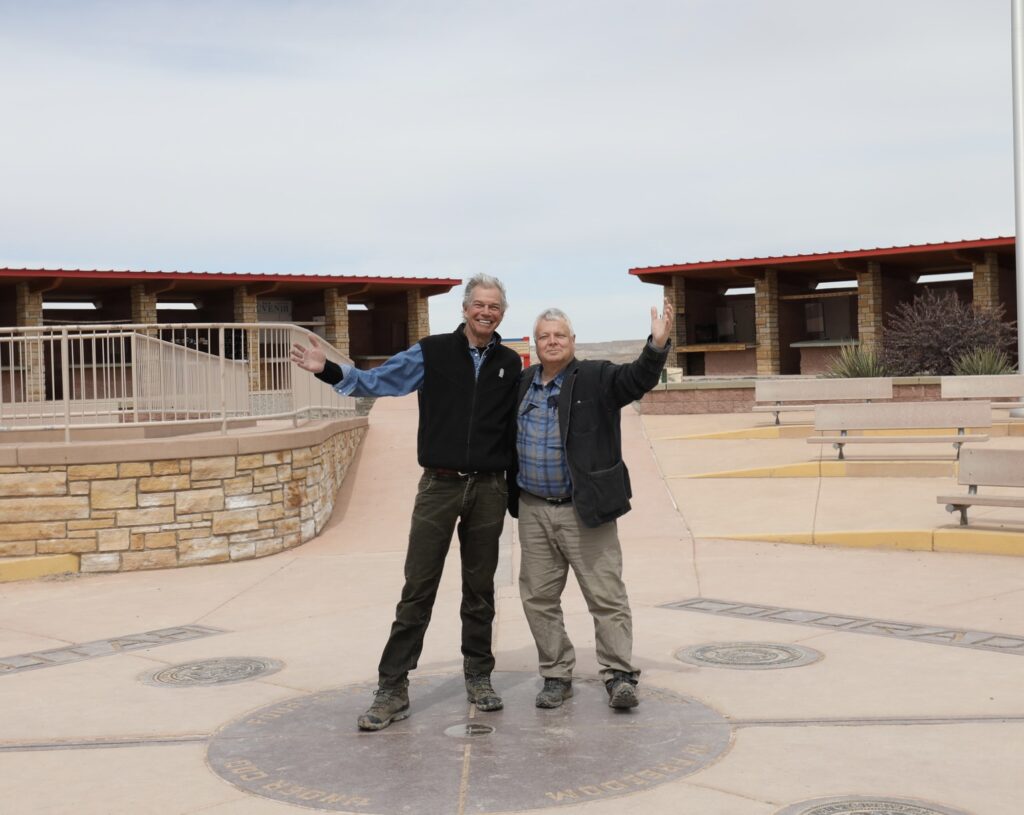
So the next day we drove to Four Corners. I tried not to be over-eager, so I mentioned it only five or six times per hour. At 11:15 a.m., when we were about 45 minutes from the Four Corners turnoff, they looked at each other (have I mentioned that neither one of them ever asked if I minded being stuck in the back seat for many hours per day, day after day after day!) and Dennis said, “I’m suddenly hungry. I’ve got to eat some food. Frank, you don’t know a good restaurant around here, do you?”
“Well,” Frank replied, “I don’t know if they qualify as restaurants, but I know a couple of cafes, if that is ok with you.” Frank could be snarky, especially when he sensed that Dennis and I were being urban snobs. So we weren’t allowed to ask the server (a 20-year-old in a blue jean skirt) at the Rim Rock Café, “Tell us about your white wines?” Frank frowned on that sort of behavior.
So we drove another couple of minutes and voilà, there was the All You Can Eat: We Mean It Café and a mostly empty parking lot. Apparently, the great noon rush hadn’t come yet. All through the meal, Frank kept saying to me, “Hey. Go get another plate. The fried chicken is outstanding here. And don’t forget biscuits and gravy. Try the onion rings.” The meal was delicious.
So we got back into the car after eating approximately three times the suggested daily amount. To tell the truth, I was a little tired after that big lunch. In spite of my great joy in being out with my trusted friends in the Southwest, with plenty of time to explore this great region, and though I fought it, I soon put my head back and fell asleep.
A few minutes passed, and I half came out of my postprandial coma. I heard my two close friends up front leaning in to each other. “You saw me put the Nyquil tablet in his coffee back there. If he stays asleep for 24 more miles, when he wakes up we can say we’re too far down the road now, no time to turn around; we felt that if you really wanted to stop you would not have taken a nap. That kind of stuff.” “I like it,” the other one said. “Watch out for potholes. He’s a light sleeper.”
You see how mobs work? I don’t think either one of them would have done this dirty deed alone, but high above the road in a Ford F-150 Turbo, hogging the front seat, they formed a dangerous elixir.
I waited about two minutes and then “woke up,” sat up straight, looked at the mile markers and my map, and said, “Oh, I’m so relieved. We’re just about there. I need to get into my boots. I thought maybe I had slept through the turnoff.”
Dennis said, “We would have awakened you.” Frank said, “What he said.” I could tell Frank was lying because it was the first three-word sentence he had ever spoken.
So I had to let it go. But trust, once broken, is a hard circle to repair.
To shame them, I bought each of them a souvenir hand-carved (and hand-painted) wood keychain with the four states clearly marked on it.
Frank Lister was the kind of man you were just always happy to be around. He made us all happy to be alive.