Travels With Charley Road Trip
Beginning in May 2024, noted historian and humanities scholar Clay Jenkinson will trace John Steinbeck’s 10,000-mile trek around the USA. Steinbeck immortalized his 1960 cross-country excursion in his classic book Travels with Charley.
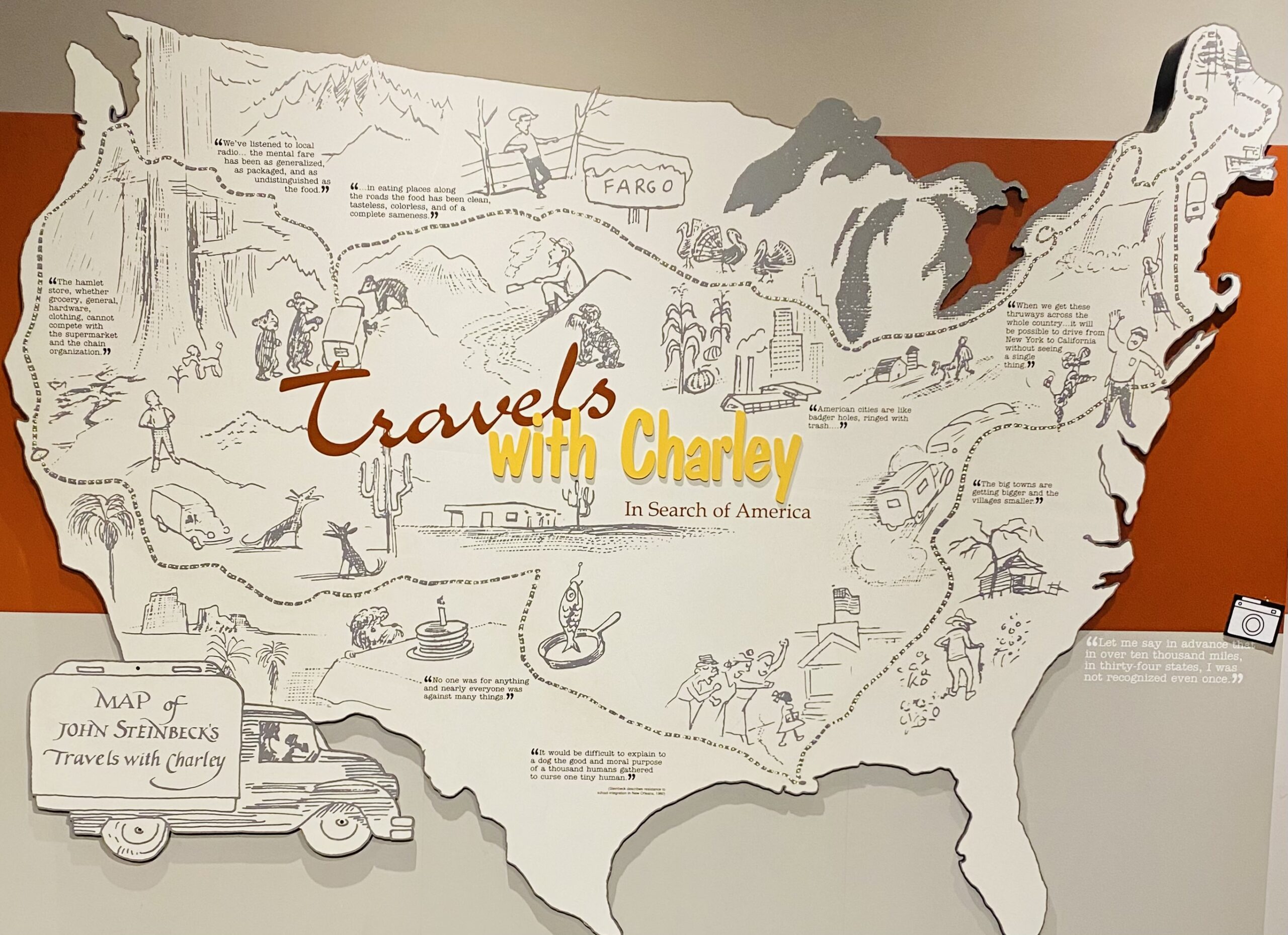
You can follow Clay’s adventures here at LTAmerica.org, on our Facebook page, and by subscribing to our newsletter.
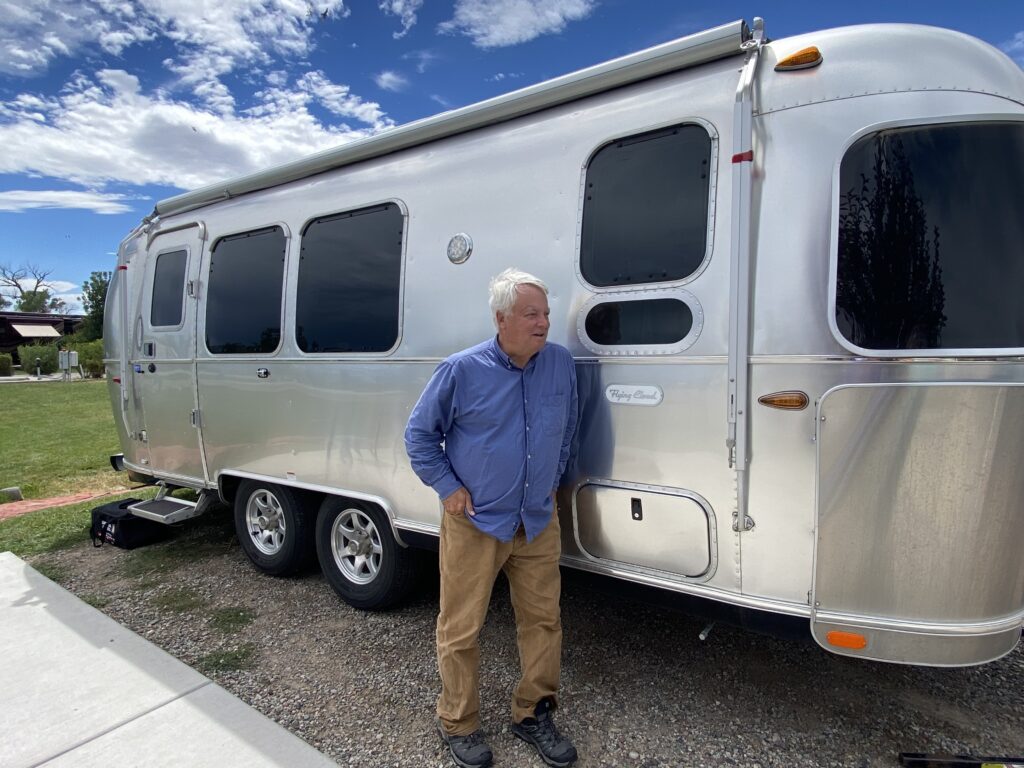
Traveling in a 23 foot Airstream and making a few detours of his own, Clay’s expedition is a central part of LTA’s big initiative to explore the country and take the pulse of America as it approaches its 250th birthday.
In his own words, Clay lays out some of the why and how of his ambitious and exciting Steinbeck Travels With Charley journey:
- First, to follow Steinbeck around this “monster country,” as he called it, from Long Island to Seattle, from Seattle to San Diego, from San Diego to New Orleans, New Orleans to Manhattan. But I won’t be doing this slavishly. I will hew close to his route, but not with an obsession to be on every road and stop in every place we can ascertain he stopped.
- Second, to search for America’s soul as we approach the 250th birthday of the United States. The emphasis will be as much on trying to make sense of this “monster country” as on retracing Steinbeck’s 1960 journey. We are a different nation now. He made his journey on the other side of the Civil Rights Movement, Vietnam, Women’s Liberation, and Watergate. His book can seem quaint in the face of all that has changed and the social and cultural revolutions of the last 60 years.
- Third, I want to occasionally venture away from the route to see things he didn’t see. Doing too much of this would dilute the journey and the theme, but doing none of this would be approaching the journey too literally, with too much constriction.
- Fourth, I intend to read everything Steinbeck wrote during the trip. The journey will be the trajectory on which I read through Steinbeck, from his first short stories and Cup of Gold (1929) to his last published book, America and Americans(1966). Thanks to iPad technology, I can carry Steinbeck’s complete works with me without ruining the shocks on the rig!
- Fifth, thanks to the digital revolution, I’ll post podcasts, interviews, photographs, and other reports from the road. Followers can join the trip vicariously and suggest people I should meet, places I should visit, and things I should consider as I travel.
I won’t do the journey in one fell swoop. I plan to break it into shorter journeys, then come home for a few weeks to process the materials, do my laundry, and regroup.
[mapster_wp_map id=”11585″]Projected Segments:
I — Sag Harbor (Long Island) to Bismarck, North Dakota
Steinbeck left his home on Long Island on September 23, 1960, and arrived at Bismarck, “where the map should be folded,” on October 12. He drove to the top of Maine because he had a whim to get to the upper extreme of the continental U.S., then traveled along the Great Lakes briefly in Canada and arrived in North Dakota on Columbus Day.
II — Bismarck to Monterey
This journey will go from the capital of North Dakota to Puget Sound and then down past San Francisco to Monterey. I hope to spend as little time on the interstate highway system as possible.
I — Sag Harbor (Long Island)
to Bismarck, North Dakota
Steinbeck left his home on Long Island on September 23, 1960, and arrived at Bismarck, “where the map should be folded,” on October 12. He drove to the top of Maine because he had a whim to get to the upper extreme of the continental U.S., then traveled along the Great Lakes briefly in Canada and arrived in North Dakota on Columbus Day.
II — Bismarck to Monterey
This journey will go from the capital of North Dakota to Puget Sound and then down past San Francisco to Monterey. I hope to spend as little time on the interstate highway system as possible.
II — Bismarck to Monterey
This journey will go from the capital of North Dakota to Puget Sound and then down past San Francisco to Monterey. I hope to spend as little time on the interstate highway system as possible.
III — Monterey to Amarillo
This segment goes through the Imperial Valley, beyond San Diego to the Salton Sea and the U.S.-Mexico border — a place of much greater national interest in our time than in Steinbeck’s. Then, eastward, using as much of Route 66 as possible, to Amarillo, where Steinbeck met Elaine for Thanksgiving 1960.
IV — Amarillo to New Orleans
Texas is a big state. I’ve never had the opportunity to drive all the way across and visit Lyndon Johnson’s home country, Galveston, Dallas, Fort Worth (with an emphasis on Steinbeck’s friend JFK), and much more. New Orleans was the nadir of the great journey. Steinbeck lost heart for his journey after witnessing a kind of primitive racism and met several African Americans who represented different Black attitudes to segregation, integration, race relations, and the future. At this stage of the journey, I will try to make sense of what has changed and what has not yet changed in race relations in the United States.
V — New Orleans to Manhattan
At this point, tired and weary of the road, Steinbeck was ready to fold himself into the arms of his wife Elaine. Steinbeck rushed home. However, I will take the time to wander up the east coast of the United States with stops all along the way, including Jefferson’s Virginia, the Outer Banks, Richmond, Philadelphia, and Baltimore. I intend to drive across the Hudson to New York City. After a day or two at the J.P. Morgan Library examining the original manuscript of Travels with Charley, I’ll make my way home to Dakota.
Buttons for CTAs — donations, suggestions (Frank)
FB link
legend and route on map — traveled vs upcoming maybe approx dates? Copy for every page or edit builder this page so we can pull all of the videos and articles for the trip (talk to Fran)
I intend to see much that Steinbeck saw back in 1960 but with 21st-century eyes and to see much that he did not take time to see in his somewhat rushed journey.
Steinbeck’s themes were American restlessness, regionalism, the coming of fast food culture, loss of American integrity, race, and the realization that “you can’t go home again.” Some of those dynamics continue to characterize the America of 2024.
We will publish articles, videos, and audio interviews throughout the journey. Like Steinbeck, I will stay in motels often enough to do laundry, but mostly — and more than J.S. — I will sleep in the rig in campgrounds and national forests, on BLM land, and from time to time in Walmart parking lots, assuming the corporation still permits overnight stays.
I won’t take a dog because it would be an incumbrance, and I cannot keep a Chia Pet alive. I’ll take other road books on the journey, including Kerouac’s On the Road, Least Heat Moon’s Blue Highways, Pirsig’s Zen and the Art of Motorcycle Maintenance and others.
I recently spoke with a man who operates a historical site in South Dakota. No sooner had I explained my purposes than he said, “Can I come along?” Steinbeck was right about that.

LTA aims to “light out for the territories,” listening to voices of America’s past & present to share balanced, humanities-based perspectives on this great nation. Join us! LTAmerica.org